

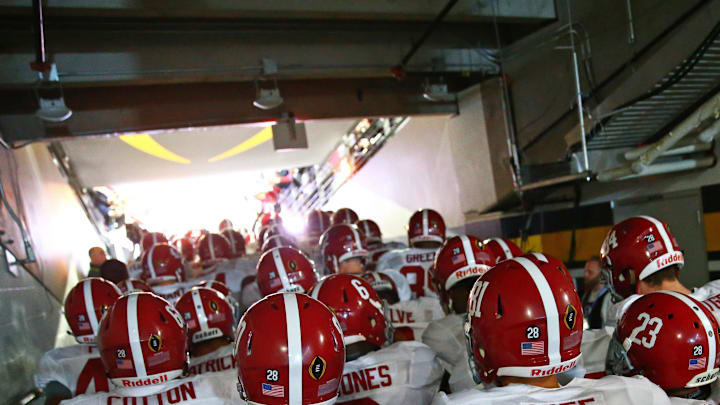
In society, rules aren't meant to box you in; they're meant to keep you aligned. The ones who succeed long-term aren't the ones who improvise every day; they're the ones who understand which principles are nonnegotiable and which situations demand discipline over impulse. That same truth applies to Alabama football in 2026, as Kalen DeBoer prepares to embark on a pressurized 3rd season in Tuscaloosa.
I strongly feel this way because, in life and in football, the margin between dominance and disappointment always comes down to following the right rules and avoiding bad habits when it matters most. This is why I've determined a set of do's and don'ts that will more than likely help sink or swim DeBoer and his Crimson Tide ship this fall when it comes to meeting and exceeding expectations, or embarrassingly falling beneath them altogether.
Alabama football should do these things
1.) Fully lean into Alabama's offensive idenity under Kalen DeBoer:
One of the quickest ways elite programs lose their edge is by half-committing to who they are. DeBoer's offenses have always been at their best when they're decisive, rhythm-based, and unapologetically aggressive in how they attack defenses in space.
In 2026, Alabama can't afford to straddle the fence by mixing old habits with new philosophies. That means trusting timing throws, spacing concepts, tempo control, and calculated aggressiveness-even when the game script grows uncomfortable. Identity creates clarity. Clarity breeds confidence. This will be easier said than done, but I think if Alabama successfully commits to its offensive DNA instead of defaulting to conservatism, it will raise both its weekly floor and potential postseason ceiling.
2.) Weaponizing the versatility across the roster:
In modern-day college football, the best teams are often rewarded by optionality more than specialization. The elite programs don't just have talent, they have answers. Alabama's roster is deep enough to create matchup stress if versatility is treated as a feature, not a fallback. Hybrid defenders, positional-flex skill players, and multifaceted linemen who can shift protections, which will allow both offensive and defensive staffs to dictate their terms instead of reacting. When injuries hit or when opponents force Plan B football, versatility becomes survival. In 2026, Alabama's edge won't be about having the best 11 on the field; it'll be about having the most adaptable 22.
3.) Dominate situational football:
Elite teams often tend to separate themselves in moments most fans gloss over: third-and-medium, red-zone efficiency, two-minute drills, sudden-change of possessions, and end-of-half clock management. These snaps almost always decide championships over raw talent. Alabama doesn't need to be perfect this fall; they need to be prepared. Situational mastery reflects coaching discipline and player buy-in. If the Crimson Tide consistently wins in these categories, close games should tilt their way without needing heroics.
Alabama should avoid these things
1.) Don't let standards drift during close wins:
It's simple, never accept anything in a win that you wouldn't in a loss. This should be the law for DeBoer and Alabama football this fall, because close games often quietly do more damage than losses if celebrated instead of examined. When execution lapses, penalties pile, or fundamentals get sloppy, but the scoreboard favors you, that's where the danger of complacency starts to creep in. Elite programs use narrow victories as correction points, not validation, just ask College football hall of famer Nick Saban and the countless teaching moments he went berserk while Alabama was en route to stacking six National Championships on their mantle. If the film doesn't match the standard, the results shouldn't either.
2.) Don't chase "style points'at the expense of control:
Explosive plays are intoxicating, but control wins championships. Pressing for highlights, forced deep shots, unnecessary tempo spikes, and risky play calls, which often hand momentum back to the opponent. The best teams dictate pace, protect possessions, and squeeze games until the other team taps out. This is why flash for Alabama should be a byproduct of dominance, not the end-all be-all.
3.) Don't ignore in-game adjustments:
There's this saying by the famous, world multi-championship winning boxer Mike Tyson goes by "Everyone has a plan until they get punched in the mouth".
For DeBoer and his young Alabama squad, many are wondering what their level of ability to adjust is if things go south in 2026. Games are living organisms, not scripts. When tendencies are exposed, or matchups flip, stubborness becomes a liability. Failure to counter punches like blitzes, protect weak edges, or adjust coverage leads to invited chaos.
Championship staffs win the second half of ball games, where adaptation separates preparation from performance. This one rule might be the most important rule of all for the Crimson Tide to successfully master this fall.
All in all, DeBoer and Alabama can either apply these metrics or let them fly by the waste side. Either way, these six keys will write the story of how successful or exposing the mood will be around Tuscaloosa when the world gathers around their TVs to watch the Crimson Tide go to battle this September.
 Add us as a preferred source on Google