

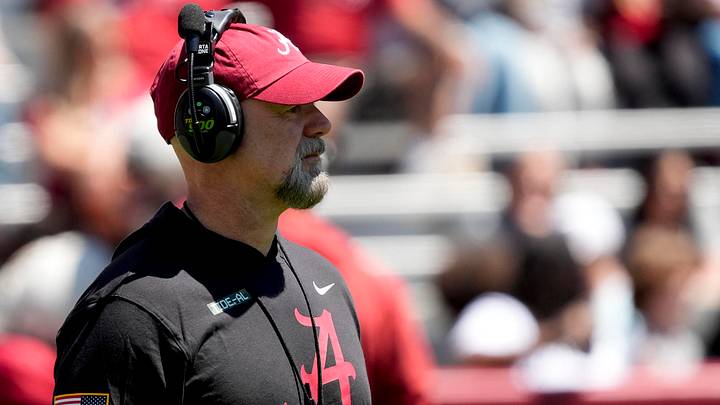
Stop me if you've heard this before, but when Alabama's offense starts slow, Crimson Tide fans become restless.
Saturday afternoon, that restlessness had already been building. A nearly two-hour weather delay tested the patience of a Bryant-Denny crowd eager to see Alabama take the field. Once play finally resumed, Florida State only made matters worse, forcing two consecutive punts while the Crimson Tide offense struggled to find its footing.
The boos soon followed.
From the skybox, second-year offensive coordinator Ryan Grubb could hear them — and knew exactly where it was coming from.
His offense.
But the boos were only the most visible sign of a disconnect that has been growing around Alabama's offense for over the past 24 months, dating back to when Grubb took over as the play caller in Tuscaloosa.
Grubb sees an offense that is closer than it looks.
Alabama fans see an offense that keeps making them wait, knowing the longer they wait, the more likely a slow start is to put the Tide in a hole it can't climb out of against a team capable of capitalizing on every mistake.
Grubb acknowledged that reaction on Monday during his weekly press conference, but rather than dwell on the boos, he pointed to the response he got from his players once the game turned.
Ryan Grubb heard the boos — then he watched how Alabama responded
Alabama Offensive Coordinator Ryan Grubb after hearing some first half "boo birds":
— The Next Round (@NextRoundLive) September 21, 2026
“I told the guys, I said, shoot, guys, if you'd have quit as fast as some of your fans. Shit, we wouldn't have won that game.” pic.twitter.com/5XujXBSqeD
“I had some boo-birds,” Grubb told reporters. "I told the guys, I said ‘Shoot guys, if you’d have quit as fast as some of your fans, shit, we wouldn’t have won that game."
In my opinion, Grubb shouldn't be surprised by the onslaught because the frustration behind it isn't exactly new.
Alabama fans have seen this movie before.
Over the last two seasons, Grubb and the Tide offense have turned slow starts into a recurring theme — from first-quarter zeros and halftime deficits against Florida State, Georgia, Vanderbilt, Missouri, South Carolina, LSU, and Oklahoma to early deficits in three postseason games against Georgia, Oklahoma, and Indiana.
That pattern carried into 2026.
Alabama survived another sluggish first half in Lexington against Kentucky before mashing the gas. Then, on Saturday, the Tide dug itself into another early hole, falling behind FSU 21-6 before storming back to win 50-36 and move to 3-0.
For fans, the frustration wasn't about one bad possession. It was the feeling that Alabama was once again making things harder than they needed to be.
Grubb, however, says he believes the offense was much closer to breaking through than the boos suggested.
“I was proud of where they were at when they took the field,” Grubb said. “Obviously, you want 12 scores in a row, but they didn’t do that. The first two drives, we had two punts. To be quite honest, we’re probably not as far off as everybody thinks. Our first third down, I think it was third-and-3, we just barely slid out of a down block on a zero [technique], and honestly, we would have had a big crease there had we accomplished that. On our third down on the next series, Lotty [Lotzeir Brooks] doesn’t quite run out of the break the way Keelon [Russell] thought he was going to. There was a ton of space on the sideline there, and we ended up about a yard short on that one. After that, they went on nine-straight scoring drives, so they did settle in pretty quickly.”
That's the disconnect.
Grubb sees inches.
Alabama fans see the pattern.
And the scary part for the Tide is both can be right.
The offense was resilient. Grubb proved that by engineering Alabama to nine consecutive scoring drives after those two punts.
But eventually, there may not be a nine-drive answer.
There will be a team like Georgia, Texas A&M, LSU, — or even a pesky South Carolina or an up-and-coming Mississippi State — that sees Alabama stumbling out of the gate and doesn't let it back into the game.
That's what fans are afraid of. Not that Alabama can't recover.
Saturday ended with another comeback and another reminder of how dangerous his offense can be when it finally gets rolling. But if Alabama keeps waiting until the game is already asking it to play catch-up, eventually the hole will be deeper than the Tide can climb out of.
And when that day comes, the slow start won't just be something Alabama survived.
It'll be the reason it didn't.
 Add us as a preferred source on Google