

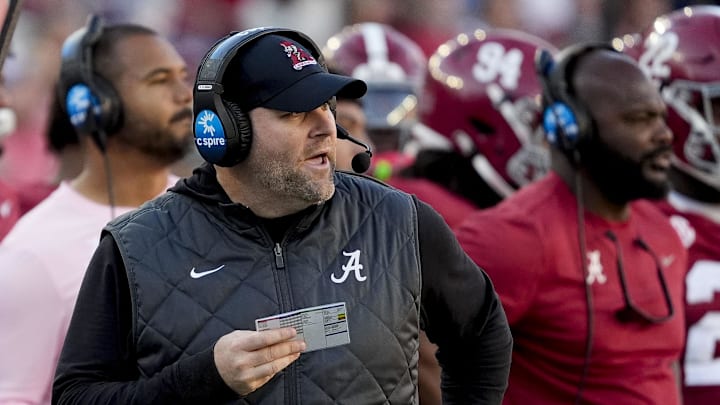
Last season, Kalen DeBoer and Alabama football never truly had something they could hang their hat on. There was no singular trait that showed up week after week — no calling card opponents feared before kickoff. They were like a toolbox missing its hammer: a few exotic pieces on both offense and defense, but nothing to drive the games home. Now, heading into 2026, I believe that the fog of uncertainty is lifting, and the Crimson Tide's identity is starting to take shape early on this spring.
DeBoer and third-year Alabama defensive coordinator Kane Wommack appear to be setting this team up with a clear foundation: a defense defined by adaptability. With versatile pieces along the Tide front seven and a talented secondary capable of holding up on the back end, Alabama is positioning itself to dictate terms rather than react — turning flexibility into its most dangerous weapon. That structure stands out as the backbone of the Crimson Tide's operation ahead of September.
I say this because every position has multiple capable backups, allowing Wommack to rotate freely without losing talent on the field. That talent starts in the secondary with one of college football's lengthiest cornerback duos in Zabien Brown and Dijon Lee, who both can cover and support the run. Talented players like Carmelo O'Neal and Jordan Edmonds back Brown and Lee. Shifting to the husky and safety position, rising junior Red Morgan brings the fire, with physical players like Zay Mincey, Dre Kirkpatrick Jr., and Chuck McDonald ready to step in on any given down. Seniors Bray Hubbard and Keon Sabb anchor the back end, backed by developing talent like Ivan Taylor and Jireh Edwards, providing options at every turn.
Up front, Alabama's front seven is just as deep. The Wolf position is led by Yhonzae Pierre, with Justin Hill and true freshman Jamarion Matthews trained to go, while USC transfer Devan Thompkins holds it down at the bandit spot, supported by South Carolina transfer Desmond Umeozulu and returning seventh-year senior Jah-Marien Latham. Across the defensive line, Oregon transfer Terrance Green, London Simmons, and Isaia Faga form a trio of disruptive interior linemen, with Edric Hill, Kendrick Bingley-Jones, Jeremiah Beaman, and Caleb Smith providing fresh legs.
Kane Wommack's claim this spring for Alabama to have dominant led defense that could be the idenity of Alabama in 2026
As Wommack himself said this spring, "One of the things that we just have to continue to do is find ways to create negative plays... we just haven't been a dominant defense, you know what I mean, consistently throughout the season. We've shown flashes of it, but I'd like to be more dominant up front." That mindset underscores why Alabama is building a roster full of versatile defenders ready to attack from every position.
The linebacker corps also combines experience and youth. Former Virginia Tech backer and senior Caleb Woodson is set to lead the charge, with QB Reese and Cayden Jones in line to anchor the inside. These three are backed by players like Luke Metz, Abduall Sanders, Xavier Griffin, Zay Hall, and Darrell Johnson, ready to rotate in when needed. This allows Alabama to mix fronts and disguise pressure packages without losing quality.
The Tide's main four-man rush — Wolf, Bandit, and two interior DTs — can consistently get after the quarterback, while run stoppers like Edric Hill, Jeremiah Beaman, Kedrick Bingley-Jones, Steve Bolo Mboumoua, and true freshmen Corey Howard can feast in backfields. Meanwhile, Alabama has the luxury of additional defender options like Fatoutoa Henry and freshman Mhari Johnson at their disposal to adjust on the fly.
On offense, the Tide's looming decision at quarterback between Austin Mack and Keelon Russell plays a big factor in this but regardless Ryan Grubb doesn't need to be flashy every play as a play caller. The talent is there, DeBoer and Grubb just have to compartmentalize those weapons with a controlled, explosive approach as they look to sustain drives and capitalize on big opportunities to complement this defensive identity. Together, this balance of flexibility and efficiency should paint the picture of Alabama football's identity in 2026.
 Add us as a preferred source on Google