

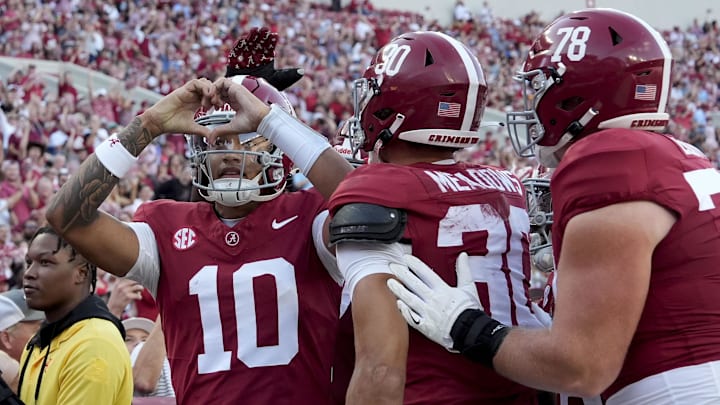
For the past decade, Alabama’s path to contention has been defined by getting through high-powered programs like Georgia, LSU, Clemson, and Ohio State, among others who stood in their way. But in 2026, as the Crimson Tide enters the heart of the Kalen DeBoer era, the biggest obstacle isn’t wearing SEC colors or those who suit up outside of it; it's the calendar.
I say this because, in a sport that increasingly punishes programs caught in between eras, Alabama’s greatest challenge this fall isn’t talent or competition — it’s whether their young pieces on both sides of the football align fast enough for it to matter. Of course, the head of that snake starts at the quarterback position, based on the decision that DeBoer and second-year Tide offensive play caller Ryan Grubb make on who will start between Austin Mack and Keelon Russell.
But QB isn't the only starting point. Alabama’s skill players — receivers, running backs, and linemen — must also align perfectly with whoever takes the helm. Timing in Grubb’s offense is everything; a split-second misread or mistimed route can stall drives and turn momentum against the Tide before they’ve had a chance to hit their stride.
On the other side of the ball, timing is just as critical. Yes, Alabama's defense is expected to be the strength of the ball club by many, due to having more continuity in their return of key players like safety duo Bray Hubbard and Keon Sabb, along with Zabien Brown, Red Morgan, and with monsters upfront like Yhonzae Pierre. But younger defenders must master alignment, coverage rotations, and gap integrity quickly because even the most talented front seven can be undone by a mistimed blitz or a blown assignment in the first half of the season.
How quickly can a young Alabama team grow up in 2026?
The question is, though, how long into Alabama's season will this process take? And how much potential leeway will they have to spare amongst other programs that also have the same aspirations of comfortably making the 12-team College Football Playoff bracket en route to competing for a National Championship? These hinging questions are why time becomes even more urgent when viewed through the lens of Alabama’s 2026 schedule.
The Tide opens the season against East Carolina and Kentucky before hosting Florida State in Week 3 — a Power 5 opponent that exploited DeBoer and company last fall. Early games like these will test whether Alabama’s young skill players, offensive line, and quarterback can execute at full speed from the first snap. Mistimed routes, misreads, or slow communication could stall drives and shift momentum against a team that’s still trying to find its rhythm. Midseason is a true crucible: Alabama faces one of the toughest gauntlet stretches in the country, going to battle against Georgia, Tennessee, Texas A&M, LSU, and Vanderbilt.
During this run, there will be no room for misalignment. Young defenders will face speed and power on every snap, and the offense must execute flawlessly to keep pace with elite SEC defenses. Any lingering timing issues from the early season could be exposed here, magnifying their impact on the Tide’s standings, which could potentially lead to DeBoer needing to add style points in the eyes of the playoff committee against Auburn when wrapping up their regular season in late November.
With all parameters considered, Alabama’s 2026 fate will be decided not by who it plays, but by when it’s ready. Talent alone will not buy time, and the schedule will not wait for cohesion to arrive. If timing becomes a strength early, Alabama remains a national title threat. If it lags even slightly, the Tide’s greatest opponent won’t be an SEC rival — it will be the weeks that slip away before execution fully catches up to potential.
 Add us as a preferred source on Google