

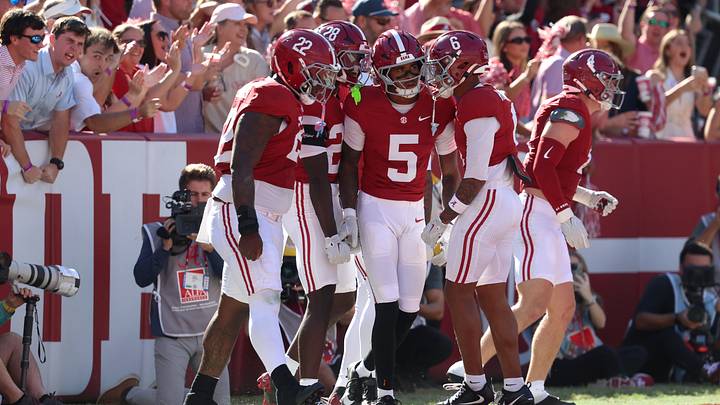
Some matchup problems are created by the player. Others are created by how an offense uses him. Through eight weeks of the college football season, Kane Wommack and his Alabama defense have experienced both, with inconsistent communication and coverage discipline repeatedly leaving its linebackers and secondary vulnerable to explosive plays.
From tangling with Florida State's Duce Robinson (6-foot-6, 230 pounds) to facing South Carolina's Nyck Harbor (6-foot-5, 240 pounds) and Georgia's Jaden Reddell (6-foot-4, 235 pounds), the Crimson Tide have repeatedly encountered physically imposing pass-catching threats who serve as focal points of their offenses.
Robinson exposed the Tide's perimeter coverage by winning vertically in one-on-one matchups, recording a 40-yard reception among his six catches for 135 yards and a touchdown. Harbor used his size and track speed to break free for a 41-yard score the following week. A couple of games later, Reddell hauled in a massive 53-yard reception that shifted field position, highlighting just how susceptible Alabama can be when bigger targets run past its linebackers or create mismatches with safeties.
Now, ahead of Alabama's highly anticipated trip to Death Valley this Saturday, the Crimson Tide defense is preparing for another transformer-like target in LSU's 6-foot-7 tight end Trey'Dez Green.
LSU TE Trey’Dez Green needs to never geaux away (clever, right?) again
— Clint Goss (@NFLDraftDome) October 24, 2026
NFL Draft TE2 needs to keep rolling his way to the 1st Round pic.twitter.com/1CRQkPBw8j
Unlike the previous three, Green operates in a high-tempo system that excels at hiding its giant targets in creative personnel packages. With LSU boasting one of the top passing games in the country, Tigers' offensive-minded head coach Lane Kiffin has found success moving him across the formation rather than simply isolating him outside, utilizing short crossers and the quick play-action concepts.
That approach has translated into 19 receptions for 272 yards and two touchdowns through eight games, with Green averaging 14.3 yards per catch — a level of production Wommack knows reflects the unique coverage challenges awaiting Alabama's defense.
Kane Wommack and Alabama's defenders know that limiting Trey'Dez Green and LSU's offense will come down to sound communication and allignment
"Anytime you have big targets, they have a large catch radius. A guy like him who can run on top of that presents a number of challenges," Wommack said. "Then, just the way college football and the NFL work in terms of using tight end personnel, this offensive staff has had a number of guys who are really good players at the tight end position in the past. This guy is second to none in that regard. He'll create a number of issues for us that we're going to have to find ways to match up with, both in how we attack a big body in man coverage and how we play him in zone from a bracket standpoint."
Wommack's acknowledgement is key but stopping Green's individual production only solves part of the problem.
LSU has consistently found ways to generate explosive plays, putting additional stress on an Alabama coverage unit that has already been burned on 76 of those this season, ranking 24th nationally in the category. The Tigers have been even more productive on the other side, sitting at 12th in the FBS with 79 explosive plays of their own.
That production is spread throughout LSU's offense with Green and three other primary targets: Jackson Harris (17.6 yards per catch), Winston Watkins Jr. (13.2), and Eugene Wilson (10.5). Together, they give quarterback Sam Leavitt multiple avenues to attack and confuse Wommack's defense — something senior safety and team captain Bray Hubbard knows the Tide must account for through discipline and sound communication.
"I mean, we've just gotta play sound in our coverages," Hubbard told reporters Tuesday after practice. "Everybody's gotta do their job. I've gotta do my job, and whoever else is in there, whatever fives is in there, we've just all gotta do our jobs and limit the explosives. We've been playing well on defense, but giving up the explosive plays can hurt you, so that's what we've gotta limit."
For Alabama, they've seen this before. The challenge now is just being able to successfully solve its familiar coverage problem with a different wrinkle — and with its college football playoff hopes hanging in the balance, the stakes couldn't be higher. Wommack, Hubbard, and the rest of the Tide defense know that they can't afford another afternoon of coverage busts. Against an LSU offense with multiple ways of exploiting them, how well Alabama handles matchups like Green and others could ultimately make or break its postseason fate.
 Add us as a preferred source on Google