

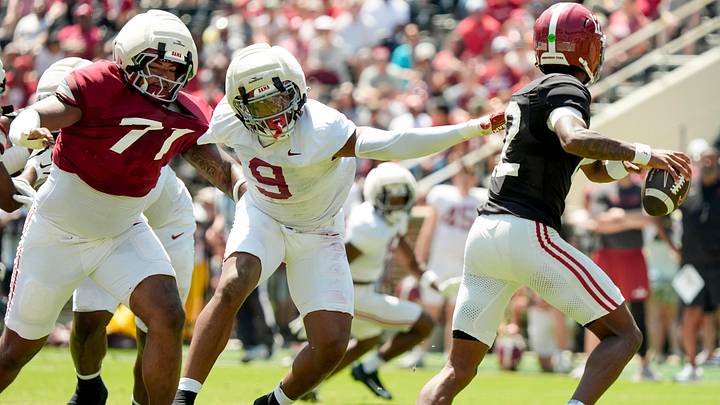
Alabama enters the 2026 regular season under a familiar spotlight, but this time with a noticeable wave of doubt surrounding its College Football Playoff credentials. Despite the Crimson Tide's routine standard of championship expectations, not everyone is convinced the roster is fully ready to navigate one of the SEC's most punishing stretches in Kalen DeBoer's third season.
That skepticism is already surfacing in national preseason discussions, as CBS Sports analyst Brad Crawford zeroed in on a defining portion of Alabama's schedule. In his assessment, Crawford didn't mince words when ranking the Tide's upcoming October stretch against Georgia, Tennessee, and Texas A&M as the seventh-toughest three-game run in the country—suggesting that a lack of consistent physicality in the trenches on both sides of the ball could ultimately be the reason why DeBoer's unit falls short of a postseason run this fall.
Brad Crawford voices why Alabama's critical three-game stretch could hold Kalen DeBoer back from reaching the CFP
"Part of the reason I do not have Alabama as a preseason playoff team is because of this three-game stretch the Crimson Tide have to face," Crawford said. "Kalen DeBoer has shown he can beat ranked teams with the Crimson Tide, but the physicality at the line of scrimmage hasn't been there. And to beat Georgia, Tennessee, and Texas A&M, you have to be physical at the point of attack."
To Crawford's point, success at the line-of-scrimmage isn't negotiable. Alabama's 2025 struggles reinforced that concern, particularly on the offensive line, where the Tide ranked 15th in the SEC in rushing yards per game (104.1 ypg) and finished outside the top 60 nationally after allowing 32 sacks. Defensively, similar issues occurred as the Tide ranked 13th in the SEC against the run while allowing 126.9 yards per game and finishing 55th in the FBS with only 33 total sacks on the year. With that context, the criticism reflects a real benchmark for championship-level physicality needed to beat teams of the caliber of Georgia, Tennessee, and Texas A&M. Because if you can't consistently win up front, October, November, and December tend to expose it quickly.
But the flip side of that argument is where the 2026 version of Alabama has already started to take shape—and why the skepticism isn't the full picture anymore.
This spring, DeBoer and staff made a clear point of prioritizing both units through continued development and the transfer portal. That intent has especially been implemented on the offensive line under new position coach Adrian Klemm. The unit now features key additions, including Cal Poly transfer center Racin Delgatty, left tackle Jackson Lloyd, right guard Michael Carroll, and expected left guard Will Sanders, as well as Mississippi State transfer Javien James at right tackle. The overall goal is straightforward: physicality, cohesion, and consistency across 12 games.
Meanwhile, Alabama defensive coordinator Kane Wommack has followed the same blueprint by reinforcing his front with key transfers and emerging underclassmen to increase depth, versatility, and gap integrity on the defensive line. Among the noticeable additions are Devan Thompkins, Terrance Green, Desmond Umeozulu—each bringing different skillsets but a shared emphasis on size, experience, and being interchangeable alongside returning contributors like Yhonzae Pierre, Justin Hill, London Simmons, and others.
Together, if both units click as DeBoer and staff intend, then Alabama will have the structural foundation on both sides to withstand that brutal three-game stretch and firmly cement itself in the thick of the College Football Playoff hunt. If not, then Crawford’s assessment won't just look like preseason doubt—it'll read as an early forecast that Alabama failed to answer under DeBoer in year three, the one area the SEC never forgives: the trenches.
 Add us as a preferred source on Google