

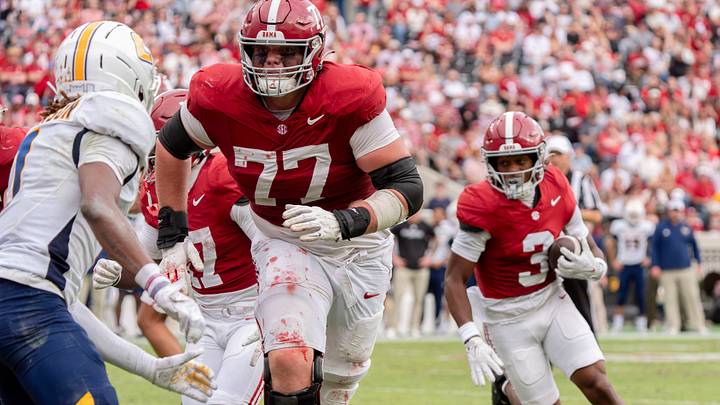
Watching Alabama's rushing attack over the course of 11 games this season has felt a lot like riding a rollercoaster in the dark—one snap you're flying downhill into open space, and the next you're slamming into a brick wall before you even leave the station.
The Crimson Tide finally looked like they found their footing on Saturday, rolling up 263 total yards on 42 carries (6.3 yards per attempt) in their 47-0 Senior Day shutout win over Chattanooga. Sustaining that success against Auburn, however, will be a completely different test.
Trying to line up and run straight into the teeth of Auburn's defensive front is a recipe for a long night inside of Bryant-Denny Stadium. That's been proven despite the Tigers' 7-4 record, as their front seven has made life miserable on between-the-tackle rushing attacks all fall, holding opponents to a pedestrian average of just 3.5 yards per carry and 141.3 rushing yards per game. Even offensive coordinator Ryan Grubb acknowledged how quickly Auburn closes space during the Tide's weekly coaches' press conference, noting, "They're a well-coached team. The defense flies to the football."
That pursuit speed is why Alabama's hit-or-miss perimeter game—specifically the jet sweep—could end up carrying so much weight on Saturday night. While Grubb didn't sugarcoat the uneven results the Tide have gotten on the edge this season, he made it clear Alabama can't afford to treat its pre-snap motions as mere eye candy.
Ryan Grubb knows he has to weaponize Alabama's pre-snap creativity against Auburn to successfully unlock the run game



"We've had a couple big hits and some mediocre gains," Grubb said. "I think there's some byproduct to that. You know there has to be a threat if you're using that motion in your game plan. There has to be a piece where you're gonna give that ball to them too. So, keeping defenses honest with that motion and that give, I think, is a big part of it, not just the actual production in the run. But it's been good; it's been truthful. It also helps our quarterbacks with some discoveries of coverages, and things like that in our passing concepts."
On paper, Grubb's "big hits and mediocre gains" assessment checks out, as Alabama's wide receivers have combined for just 13 carries for 39 yards (3.0 yards per attempt) on the season—led by Ryan Coleman-Williams (5 carries, 22 yards, 1 TD), alongside Rico Scott (4 carries, 11 yards) and Lotzeir Brooks (4 carries, 6 yards).
The "miss" side of that equation has been painfully obvious at times. Remember two weeks ago in Nashville, when Alabama's boneheaded fourth-and-1 attempt involving Coleman-Williams was sniffed out immediately and dropped for a one-yard loss against Vanderbilt. That wasn't an isolated incident either: receiver handoffs produced just five combined yards on three carries across Alabama's two losses to Georgia and Tennessee, while Brooks has yet to record a single successful rush on the year.
Yet focusing strictly on a busted fourth-down call or a low rushing average misses the real value of the Tide's intent. Against an Auburn defense that Grubb explicitly noted tends to crowd the line of scrimmage, establishing that horizontal threat early is the key to unlocking Alabama's downhill run game. Even a two-or three-yard gain on a sweep or toss forces Auburn's linebackers and edge defenders to widen their eyes, respect the boundary, and hesitate for a split second before crashing interior gaps.
That slight pause is everything an offensive line needs to generate movement on inside zone and duo threats. Because when the Tide's ground game has clicked—including Saturday's dominant showing where Grubb noted Alabama ripped off nine or 10 runs in which a defensive back was the first defender to touch the ball carrier—it has been because defenders couldn't blindly sell out in the trenches.
With College Football Playoff stakes hanging over Saturday night in Tuscaloosa, Alabama doesn't need its sweep package to turn into its primary weapon or crutch. It simply needs to be an honest threat. If Grubb can make Auburn's fast-flowing front defend every blade of grass early on, the Crimson Tide's rushing attack will have all the daylight it needs to control the Iron Bowl.
 Add us as a preferred source on Google