

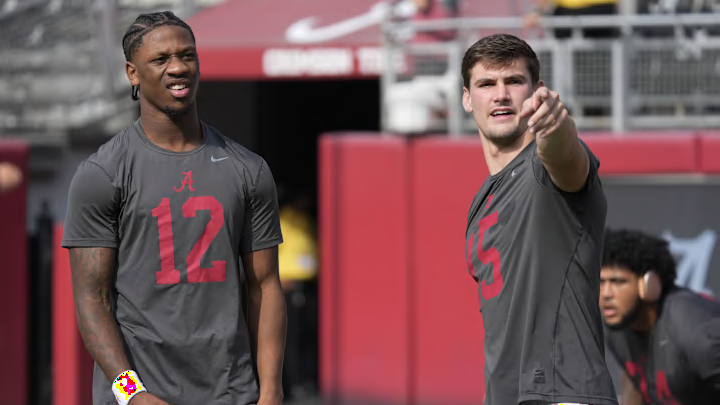
Contrary to the usual nature of competition at the quarterback position, Alabama's QB room is as close-knit as any in college football, built more on shared preparation and internal development than public separation. Rather than a constant battle of public winners and losers, the Crimson Tide has cultivated a space where every accomplishment is treated as collective progress, even as the depth chart quietly sorts itself out behind the scenes. That reality was on full display Thursday night during the 2026 NFL Draft, as Austin Mack and Keelon Russell both joined No. 13 overall pick Ty Simpson in celebration after being selected by the Los Angeles Rams.
.@ty_simpson06's college QB room was mogging with LA signs ❤️🤍@AustinMack2024 | @Pres1dential | @AlabamaFTBL pic.twitter.com/dwsbbxNUbl
— NFL (@NFL) April 24, 2026
This unified moment underscored how much of a true brotherhood Simpson, Mack, and Russell all share beyond the field, where individual ambitions haven't fractured the connection built in the quarterback room. The scene also reflects how Kalen DeBoer has framed Alabama's ongoing quarterback dynamic this spring, particularly the evolving relationship between Russell and Mack as they continue to push each other in a competitive but connected environment.
Kalen DeBoer values the genuine rapport Austin Mack and Keelon Russell have built in Alabama's QB room in the midst of battle
"I really credit coach (Ryan) Grubb, Bryan Ellis now as the quarterbacks coach, and give some props to Nick Sherridan, on how that room operates," Deboer said on the Josh Pate College Football Show. "And it was with Ty last year, and now it's without him, but Keelon and Austin, and the respect—really, the way they appear to care for one another, and I think it's pretty genuine. They've got me fooled if it's not, in a big way. They lead—not together, because they're different—but they really are leading this team, and when they're out there, both sides of the ball really appreciate how they've approached it: team first. But they are also doing their part to lead this football team."
To me, that dynamic has been a defining edge for Alabama's quarterback culture under DeBoer—one where competition doesn't fracture chemistry but instead sharpens it. This is especially rare in an era where transfer portal movement and individual branding often dominate over all other aspects. The Crimson Tide has managed to preserve something more traditional: a shared standard. Simpson's rise to the first round, paired with Mack and Russell following him into the league, doesn't just speak on talent evaluation—it reflects an environment where development is accelerated by trust, transparency, and daily accountability rather than isolation or hierarchy alone.
And as Alabama continues to evolve offensively when deciding between Russell and Mack this fall, that foundation becomes just as important as any schematic adjustment. Simpson, Russell, and Mack's celebration on draft night was more than a snapshot—it was a reflection of a system that has consistently produced NFL-caliber quarterbacks while maintaining cohesion behind the scenes. And for all sensible Crimson Tide fans, I think they all can and should appreciate how DeBoer's quarterback room has proven that internal competition and external unity don't have to exist in opposition. Instead, they can, and in Alabama's case, often do, elevate each other.
 Add us as a preferred source on Google