

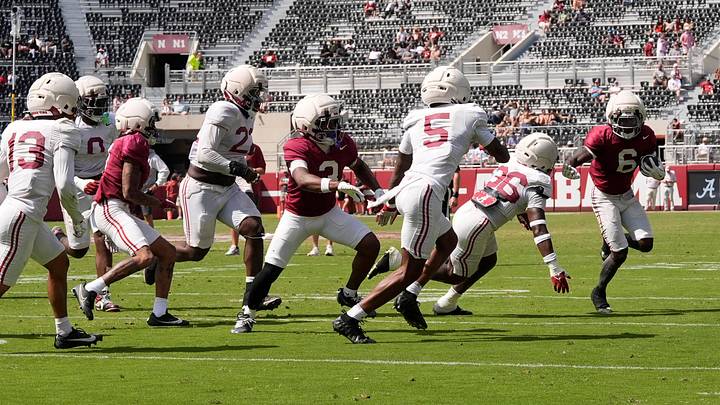
Kalen DeBoer and Alabama didn't fall short in 2025 because they lacked talent. They fell short because the Crimson Tide failed in four critical situations that define winning football.
Not explosive highlights. Not scheme mysteries. Not personal debates that dominate the headlines.
Just the most routine, high-level downs in the sport—the ones every championship contender is expected to win when games tighten and margins shrink. And when you strip the season down to its core, the pattern becomes impossible to ignore.
This team wasn't a roster incapable of competing at the highest level. It wasn't a system without answers. It was a team that repeatedly lost in the same moments—the ones that dictate drives, shift momentum, and ultimately decide seasons.
That's why 2026 can't be a rerun of 2025 with new faces—Alabama's staff has to fix the same issues that showed up when games were on the line and got out of hand. The talent is there, but the talent alone doesn't decide those moments anymore. Because, year three for DeBoer isn't about re-litigating what went wrong—it's about identifying what has to change before it costs Alabama again.
And when you break the season down to its most decisive snaps, those changes point to four areas on both sides of the ball that have to improve if Alabama is going to flip its trajectory in 2026.
1.) Offensive 3rd & long—Playing behind the chains:
This specific area was one of Alabama's most consistent offensive issues in 2025.
On 3rd & 10 or more, Alabama converted 22 of 43 attempts for (51.2%), a reflection of how often the Crimson Tide offense was forced into obvious passing situations due to early-down inconsistency in the run game.
Once cornering Ryan Grubb's unit behind the chains, defenses dictated everything—pressure arrived faster, coverages tightened, and the offense lost control of the down. Third-and-long wasn't just a difficult situation. It became too common of one.
2.) Defensive 3rd & long—Getting off the field:
Kane Wommack and his defensive staff often created the right situations in 2025, forcing opposing offenses into third-and-long, but Alabama played with its food and failed to consistently finish drives.
Opponents converted 56.7% of 3rd & 7 to 3rd & 9 situations and 68.6% of 3rd & 10 opportunities. Those are stops that should end possessions. Instead, they extended them. And over time, those extra snaps became backbreakers as drivers were extended and extra stress was added on a defense that had already done its job.
3.) Offensive Red Zone efficiency—Finishing drives:
Alabama could move the football between the 20s, but inside the red zone, that consistency faded.
In 2025, Alabama had 60 total red zone trips across 15 games, producing 43 touchdowns, 10 field goals, and 7 empty possessions due to turnovers, drops, and missed kicks. Those empty drives frustrated fans and magnified the problem.
Because in tight SEC games, that margin decides everything. Red zone football isn't about yardage—it's about finishing. It's about turning sustained drives into touchdowns instead of settling or leaving points on the board.
4.) Defensive 4th downs—Winning the money down:
Analytics at all levels of football have changed the game. Offenses are more aggressive on fourth down than ever before, and Alabama's opponents leaned into that reality throughout 2025.
The Crimson Tide allowed a 69.6% fourth-down conversion rate. In losses, that percentage rose to 100%. In my eyes, that's not just a situational breakdown, it's a momentum problem. Fourth down is the clearest snap in football—one play, one stop. And too often, Alabama's defense didn't get home.
Since these four areas were exposed in 2025, most notably in Alabama's late-season losses on the biggest stages to Georgia in the SEC Championship and Indiana in the College Football Playoff, DeBoer and his staff have spent the offseason reinforcing both lines of scrimmage and adding pieces designed to stabilize early-down efficiency and tighten situational execution on both sides of the ball. On paper, Alabama is better built to handle the exact moments that repeatedly swung games last year. But those upgrades only matter if they translate when the field shrinks, and the pressure rises.
Which is why, in 2026, Alabama's season will ultimately be defined by whether those four situational downs finally swing in its favor.
 Add us as a preferred source on Google