

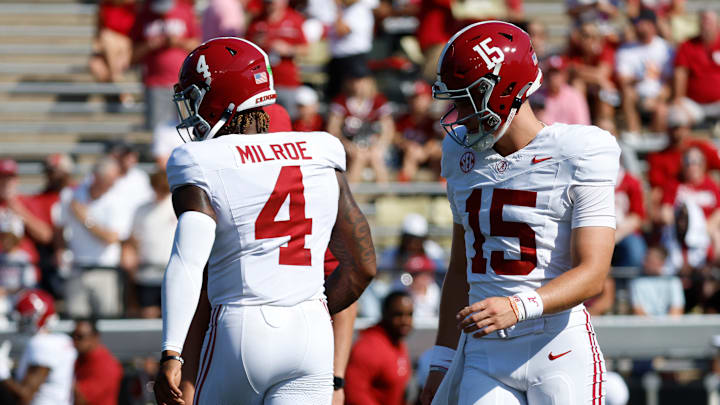
The last couple of years, Alabama fans have never been shy about the quarterback debate between Ty Simpson and Jalen Milroe. Fans calling for Milroe to be benched in the previous years in favor of Simpson. Some fans this year are wishing they had Milroe back. Now that both Simpson and Milroe are finished in Tuscaloosa with the former declaring for the draft, the conversation finally has some closure and clarity. This is not about who felt better in the moment or which style fans preferred. This is about production, efficiency, and impact. The numbers don't pick a winner outright, but they absolutely frame the argument.
Explosiveness vs. Efficiency
Milroe's resume jumps off the page immediately. Over his Alabama career, he accounted for more than 7,500 total yards, combining 6,016 passing yards with 1,577 rushing yards, while producing 78 total touchdowns (45 passing, 33 rushing). His ability to change a game with one play, especially with his legs, forced defenses to play Alabama differently every single week. Designed quarterback runs, red zone carries, and broken play scrambles weren't just wrinkles; they were the foundation of the offense.
Simpson's statistical profile tells a different story, one built with control and precision. In his final season, and lone season as a starter, he threw for 3,567 yards, 28 touchdowns, and just 5 interceptions, posting a QBR around 76. That QBR placed him among the more efficient quarterbacks in the country. His completion percentage hovered in the mid-60s despite heavy volume, and Alabama's offense often looked calmer, methodical, and rhythmic under his command.
Risk, Reward, and Decision Making
Turnovers are where the contrast sharpens. Milroe's aggressive style led to more interceptions and turnovers, but at the same time, led to explosive scoring bursts that could flip games instantly. Simpson's lower interception rate reflects a quarterback who prioritized ball security, situational football, and sustaining drives. While Milroe's offense was known for its explosive plays, Simspon's was known for the carefully calculated drives as he made adjustments at the line of scrimmage.
Rushing production further separates the two. Milroe wasn't just mobile; he was a featured runner. He posted double-digit rushing touchdowns and forced defenses to account for him at every level. Simpson used his legs selectively, scrambling when necessary but rarely as a designed weapon. That difference alone explains much of the gap in how their respective offenses were structured.
Team Success and Legacy
Team success followed both quarterbacks. Milroe led Alabama to an SEC Championship and a College Football Playoff appearance. Simpson, in turn, guided the Tide back to the playoff, delivering one of the most efficient passing seasons Alabama has seen in the modern era. Neither quarterback was able to bring a national championship back to Tuscaloosa.
If you value sporadic but explosive, physical dominance, and total yardage production, Milroe's numbers make a powerful case to be your QB of the two. If you value efficiency, ball security, and methodical offense, Simpson's resume is equally compelling. Same program. Same standard. Same results for both when it comes to being a national champion. Two very different paths to success in Alabama's offense.
The stats don't end the argument; they start it. Advanced metrics can be pulled out and touted online to make the case of which quarterback was better in their respective starter roles. At the end of the day, this debate probably says more about Alabama fans than it does the quarterbacks. Some want fireworks and chaos. Others want control and consistency. Milroe and Simpson delivered winning football in their own way, under the same expectations and pressure that come with wearing crimson. The rest is preference.
 Add us as a preferred source on Google