

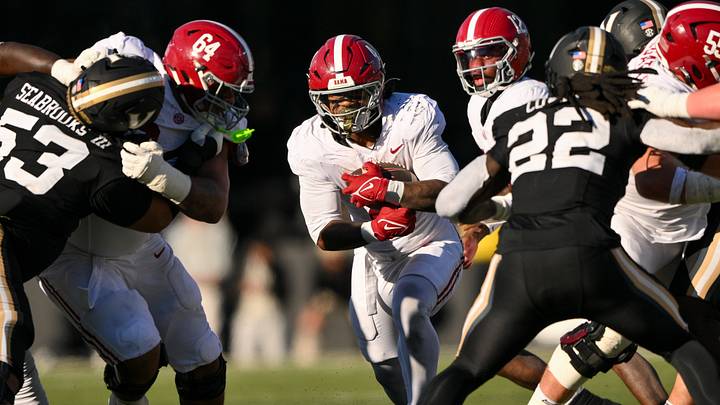
Alabama got out of Nashville with a 21-6 win over Vanderbilt on Saturday, moving to 8-2 and avenging its 2024 upset loss at FirstBank Stadium. Yet today's performance — defined by a scoreless first quarter and another early stagnant afternoon on the ground — proved that the same glaring flaw following this offense all November refused to go away.
Coming off a 79-yard, 2.7-yard-per-carry slog at LSU, offensive coordinator Ryan Grubb didn't bother starting the week with coachspeak. He opened Monday's press conference with a blunt assessment of the Tide's ground game: "No media line bulls***, but we got to focus more on the run game, and it's going to get fixed."
Six days later, the Crimson Tide's rushing attack looked just as broken as it did in Baton Rouge.
If you glance at Daniel Hill's stat line, it's easy to miss the problem.
Hill ran physical, broke tackles, and carried the load with 89 yards on 14 carries (6.4 yards per carry), including a 20-yard burst. But take away Hill's individual effort, however, and the rest of the offense's rushing numbers against a now 4-6 Vanderbilt squad — which entered Saturday ranked 66th nationally in run defense at 147.3 yards allowed per game — tell the real story: 17 carries for 6 net yards (0.35 yards per attempt).



The split exposes the real flaw in Grubb's offense. Alabama didn't fix its run game this week; Hill simply masked it.
Daniel Hill’s big afternoon hid a much larger problem in Alabama’s rushing attack
Despite spending all week preaching commitment to the ground game, Grubb's play-calling showed no real shift in philosophy — at least in my eyes. Alabama threw 34 passes compared to 31 total rushing plays for 95 net yards — averaging just 3.1 yards per carry and extending the Crimson Tide's drought to four consecutive games without reaching 100 team rushing yards. Even worse, only 19 of those 31 carries went to actual running backs despite starting quarterback Keelon Russell playing on an injured ankle.
Grubb also failed on his Monday vow "to get the ball in the right people's hands". Outside of Hill, the rest of the Tide running back room managed just five carries for seven yards — three for season-leading rusher Trae'shawn Brown (three yards) and two for an injury-riddled EJ Crowell (four yards). Leaving one back to shoulder nearly three-quarters of the load isn't a balanced attack — it's an overreliance that won't hold up against physical fronts down the stretch.
With its final two regular-season games at home under the lights of Bryant-Denny Stadium and a 97% chance to reach the College Football Playoff, Alabama has plenty to feel good about. But doing just enough to get by against Vanderbilt with today's effort isn't the standard in Tuscaloosa — being able to power run the football with more volume at a higher success rate in mid-November into December and January is. Against a struggling Commodores defense, Hill's individual toughness was enough to hide a lack of push up front and another week of unbalanced play-calling.
Once the playoff starts, however, that mask comes off. Elite defensive fronts in the postseason won't let one running back carry an entire ground game by himself while an injured quarterback takes unnecessary punishment. Until Grubb backs up his intentions with real balance and physicality in the trenches on a weekly basis, Alabama's rushing attack isn't fixed — it's just surviving on borrowed time.
 Add us as a preferred source on Google