

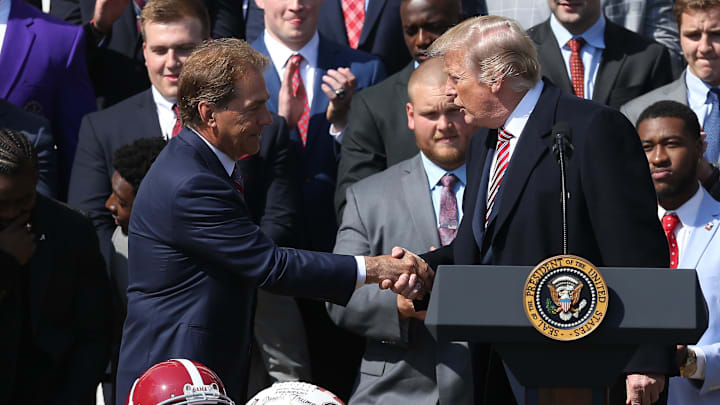
The debate surrounding the future of college athletics rarely lacks strong opinions, but when someone with the resume of a beloved figure in the game like College Football Hall of Fame head coach, Nick Saban speaks, the conversation tends to carry a little more weight. That's because very few have had the amount of true motion and close lens view of how the system truly works, and how quickly it all can change than the longtime architect of Alabama's dynasty.
At a time when the landscape of college athletics is as shaky as it's ever been, former Saban used his platform in Washington to express his concerns about the direction of the game. The former Alabama head coach spoke this past Friday during a college sports roundtable hosted by President Donald Trump at the White House, urging lawmakers to address the growing issues surrounding Name, Image, and Likeness (NIL) across the collegiate ranks. Saban emphasized that while NIL opportunities have opened financial doors for student-athletes, they have also shifted the focus away from academics — something the 73-year-old should be held in high regard as a core value that should remain the foundation of the college experience.
Nick Saban stands his ground and voices his opinion on the landscape of today's NIL nightmare in NCAA
College football's most decorated head coach Nick Saban spoke at the White House on Friday at a college sports roundtable hosted by President Trump.
— CBS News (@CBSNews) March 7, 2026
Saban called on lawmakers to fix issues he has seen at the collegiate level, where Name, Image, and Likeness (NIL) deals have… pic.twitter.com/cFN4QVaT2i
In my mind and in many ways, the 7-time National Championship architecture suggested that the current environment is like building a house while ignoring its floor plans; the structure may be without a strong base, leading to an uncertain future, longevity-wise. Unfortunately, his words did not sit well with most who heard them in the last 48 hours, listening to many fans, pundits, and even some athletic figures ridicule Saban's intentions all due to the past blueprint he famously put together during his histrionic 17-year tenure in Tuscaloosa that many tried to duplicate but couldn't.
This kind of negative talk led several of Saban's most memorable stars to speak up on social media to set the record straight on their former head coach's intentions. That was apparent when former Tide defensive back and now Alabama football director of player development, HaHa Clinton-Dix cleared the air on X Sunday evening.
Former Alabama players back Saban online after countless backlash remarks
Amazing how people keep misreading Coach Saban. He never said players shouldn’t get paid — he actually supports it.
— Ha Ha Clinton-Dix (@haha_cd6) March 8, 2026
His point was that college football needs structure: revenue sharing, real NIL deals, and clear rules. Right now it’s chaos with collectives, nonstop transfers,… https://t.co/ks7bIQPyW1
Clinton-Dix's comments aligned similarly with former Tide linebacker, Christian Miller's response when replying to former USC safety Su'a Craven and others who've gone on the ledge of accusing Saban of being hypocritical during this process.
Brother speak to anybody that played for him, including myself, and you will get the same answer. He genuinely cares about his guys. That said, he isn’t saying they shouldn’t get paid, just it should be structured through revenue sharing and authentic NIL to maintain parity by…
— The Millers’ Edge (@TheMillersEdge) March 8, 2026
In the end, these pushbacks from former Alabama players and others have somewhat helped clarify what Saban is actually arguing, in my estimation. Voices like Clinton-Dix and Miller's simply emphasize that their former coach and mentor isn't against athletes making money in today's collegiate landscape. But instead, viewed that the current NIL melting pot lacks structure and is drifting away from the original recipe of the plot. While critics across the country question Saban's motives, those who played for him all sing the same tune of his comments as an attempt to protect the long-term health of the game rather than criticize the athletes who benefit from it. All in all, this discussion is something that will continue to be controversially discussed until the NCAA's leaders set proper guidelines to get this right once and for all. And with Saban currently driving his hammer into the wood of the argument, it'll be interesting to see if his comments drive change in the coming future.
 Add us as a preferred source on Google