

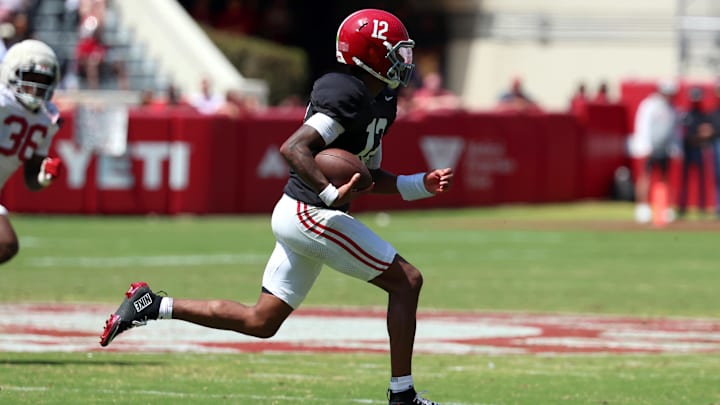
Trying to revive the Alabama run game in the early stages of 2026 has felt like trying to restart a stalled engine—you can keep turning the key with the same approach, but until you introduce a spark from somewhere new, nothing really changes. For Kalen DeBoer and second-year offensive coordinator Ryan Grubb, that spark might not solely come from the running back room or a reshuffled offensive line, but from a different demonstration at quarterback. And after watching the flashes Keelon Russell showed on Saturday during A-Day—not just with his arm, but with his feet—he could be that ignition point, the piece that finally gets the Crimson Tide's rushing attack cranking again this fall.
That intent showed up clearly in how DeBoer and Grubb scripted a handful of zone-read and run-pass option (RPO) concepts specifically for Russell during his nine series of action. Rather than limiting him to a traditional dropback passer, Alabama intentionally put him in situations where the read defender had to account for both the mesh point and his ability to pull and create with his legs—turning simple run concepts into a stress test for the Tide defense, which had to diagnose him in real time. On those snaps, Russell didn't just execute the read; he expanded it, showing burst and lateral quickness that forces the edge to hesitate and linebackers to widen, subtly altering how the entire front fit the play.
That usage stood in sharp contrast to how Alabama handled Austin Mack in similar situations on the five possessions he was in at quarterback, where the looks were far more contained and pass-centric, with far less emphasis on designed plays with his involvement in the run game. Mack was primarily operated as a distributor, tasked with processing and delivering the ball quickly, while Russell was given the green light, even in small doses, to become an active part of the run equation itself.
Yes, for what it's worth, DeBoer did mention to reporters after the scrimmage that Mack had been dealing with an undisclosed injury and that he was "a bit banged up", which may have limited him to a degree, but that distinction didn't feel accidental in my eyes. It hinted at what Alabama has been quietly exploring with Russell all spring: a true dual-threat presence under center that doesn't just complement the offense, but reshapes how the run game is structured altogether, instead of simply tagging along with it.
It is also important to note that Russell displayed this type of athleticism before committing to Alabama as a five-star prospect in 2024, when rushing for over 570 rushing yards in his career at Duncanville High School in Texas. This previous body of work, along with what the redshirt freshman has shown in glimpses in Tuscaloosa, is what Grubb alluded to as a possibility in March during the opening stages of spring practice when discussing what separates Russell from Mack and how that skill set could eventually factor into the offense.
Ryan Grubb hints how the athleticism of Keelon Russell can be a game-changer for Alabama in 2026
"Obviously, Keelon is a really, really good athlete," Grubb said. So, I think his feet probably come into play. I think you saw in the Rose Bowl that Austin could run a bit. He had a scramble touchdown during the season as well, so it's not like Austin can't run, but there's a piece of athleticism with Keelon that's different than some guys."
This evaluation could even be more important to DeBoer and Grubb after seeing the Alabama run game look stagnant at times against its own defense, managing just 61 total rushing yards across 31 combined from Daniel Hill, Kevin Riley, AK Dear, Trae'shawn Brown, and Khalifa Keith. That's where Russell's athletic profile starts to become less of a package add-on and more of a defensive constraint. When he's on the field as a legitimate run threat in zone-read and RPO structures, opposing defenses will be forced into accounting for his athleticism as a runner on every snap the ball is at the mess point. That single adjustment can alter how an entire defensive front plays Alabama before the ball is even handed off.
Linebackers can't trigger downhill as aggressively. Edge rushers can't cheat ahead and crash as freely. And safeties are forced to play with deeper and more cautious leverage. That split-second of hesitation might not show up on the stat sheet, but it shows up everywhere else—in wider creases, cleaner double teams, and running backs hitting the line of scrimmage with more momentum instead of resistance.
This would represent a stark contrast from how Alabama operated its offense a season ago under Ty Simpson at quarterback, when RPOs accounted for just 10.1% of his completions in 2025. In that context, Russell wouldn't simply be adding another wrinkle to the offense—he would be changing the math of the run game itself. And if he ultimately emerges as QB1 this fall, it won't just signal a change in personnel, but a structural shift in how Alabama defines, stresses, and unlocks its rushing identity in 2026.
 Add us as a preferred source on Google