

We can argue in circles for days about whether the SEC or the Big Ten is the best conference in college football this year, but the general understanding as we’re down to the final seven meaningful games of the season is that the SEC is/was deeper, and the Big Ten has the more serious national title threats.
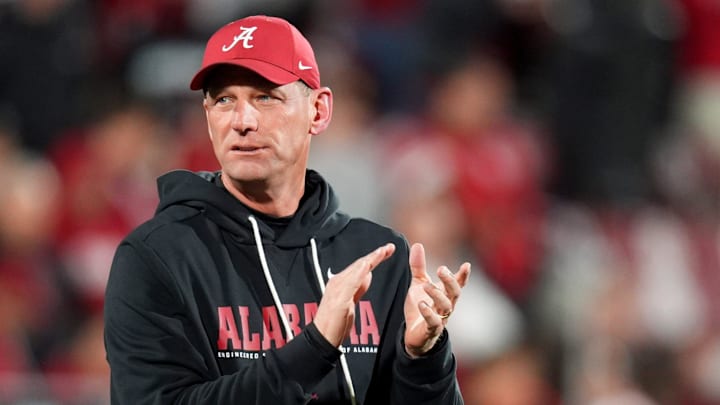
Indiana is one of those three national title threats from the Big Ten, and the No. 1 Hoosiers have beaten the other two, downing Oregon in Eugene in the regular season and besting Ohio State in Indianapolis for the Big Ten Title. While it’s hard to make a rational case that Alabama has been on the level of the Ducks and the Bucks this season, Kalen DeBoer’s team may present a tougher matchup for Curt Cignetti in the Rose Bowl, at least on one side of the ball.
Why Indiana’s base defense has smothered Big Ten offenses
Indiana defensive coordinator Bryant Haines was deserving of head coaching interest this cycle, and will be a hot name next time the carousel starts to spin. A big reason for that is the way his unit performed against Oregon, limiting the Ducks to 13 points in a 30-20 win, and Ohio State, holding the Buckeyes to just 10 in a three-point victory.
What makes Haines’s defense so unique is that he lives in base. The Hoosiers play a base 4-3 scheme, and unlike most of college football, they’re reluctant to put a nickel on the field. Oftentimes, Haines will even match 11 personnel (1 running back, 1 tight end, 3 wide receivers) with base, leaving just four defensive backs on the field.
Indiana’s linebackers are good coverage players because he has D’Angelo Ponds, a lockdown boundary cover corner, Haines can survive with bigger bodies on the field. Three-linebacker looks, with Aidan Fisher, Rolijah Hardy, and Isaiah Jones, have been excellent against the run, with the defense as a whole ranking 21st in rushing success rate and 19th in EPA/rush.
Oregon and Ohio State, with elite offensive coordinators who both took head coaching jobs this offseason, played right into Haines’s hands. Both of those offenses have morphed into 12-personnel attacks (1 RB, 2 TEs), forcing the defense into conflict. Stay small with five DBs, and they’ll run it down your throat. Get big to stop the run, and it’s bombs away over the top.
For the season, Indiana has been susceptible to the explosive passing game, allowing a 43rd percentile explosive pass rate of 9.3 percent. But, Indiana, predictably, stopped the run in both matchups, allowing -0.07 EPA/rush and -0.62 EPA/rush, respectively. And, with only two wide receivers on the field much of the time, Indiana could still roll coverage towards the No. 1 threat with its four defensive backs. IU allowed just four total explosive passes across the two games.
Alabama can’t run the ball, and shouldn’t bother to try
The way to beat the Hoosiers isn’t getting big; it’s spreading them out. And while DeBoer and Ryan Grubb don’t run a super-spread air-raid system or the veer-and-shoot offense that is proliferating the SEC, they do live in 11 personnel and do a masterful job creating space for their wide receivers. That’s a huge part of why Alabama has an 85th percentile explosive pass rate of 10.9 percent, and that would likely be even greater if Ryan Williams hadn’t struggled with drops so much this season.
As I said, Indiana will even match 11 with base. It may not happen all the time, but they will give Alabama some of those looks, which means one-on-one across the board and very little safety help, if any at all. It also means a clearer declaration of where pressure is coming from, which will be a nice reprieve for Ty Simpson after his chess match with Brent Venables in the first round.
No matter the look the Alabama gets, the Crimson Tide cannot run the ball. That’s not changing in Game 15. So, DeBoer and Grubb shouldn’t even bother. They should come out in spread looks, hunting one-on-ones, and ripping off chunk plays through the air. That’s what Oregon and Ohio State didn’t do enough of, and it’s Alabama’s best chance to upset the No. 1 team in the country in Pasadena on Thursday.
 Add us as a preferred source on Google