

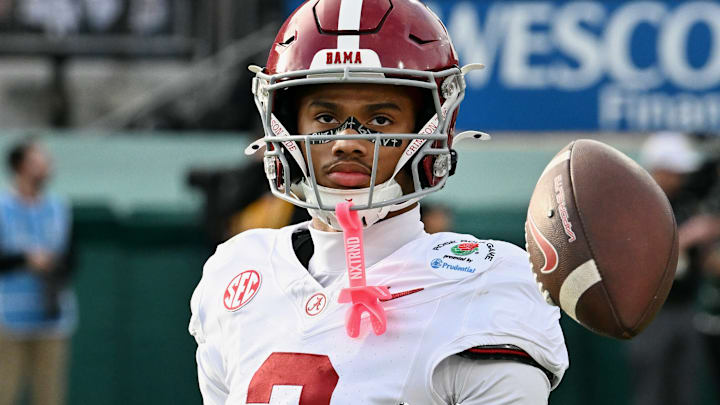
If you asked anybody who watched major college football in the fall of 2024, many would tell you that Ryan Williams was in line to be the next transcendent wide receiver at Alabama. Some would even take it a step further by saying he was arguably even the best receiver in the country as a true freshman, only rivaled by Ohio State superstar Jeremiah Smith.
Unfortunately, in the eyes of NFL draft analysts like Mel Kiper, among others, Williams' sophomore season was a big step back.
Kiper let this be known when assessing the draft stock of the quarterback who threw him the football in 2025, Ty Simpson, noticeably stating that Williams' decline, along with Alabama's other deficiencies, should be factored in Simpson's evaluation at the next level.
..."I had to go back to the notes. The O-Line was hit or miss, and Ryan Williams wasn't what we thought," Kiper said while discussing his mock draft on ESPN.
Mel Kiper said Ryan Williams 'wasn't what we thought' in 2026.
With that being partly true, even if you take Kiper's remark at face value, what it really signals isn’t that Williams “fell off” — it’s that the margin for error at the top of the WR food chain is thin. I say this because Williams didn’t regress as much as he plateaued. The Mobile, AL native still put up stats as a sophomore, reeling in 49 receptions for 689 yards and four touchdowns, compared to his electric true freshman campaign, where he first broke onto the scene with 48 catches for 865 yards and eight touchdowns.
This slight decline was notably due to him being plagued with the kryptonite of dropping the football, finishing second in the entire nation in drop rate among qualifiers, with a reported 14.3% drop rate and 10 total drops on the year. Despite these struggles, Williams explosiveness was still there, and the fear factor never disappeared, but the jump from promising true freshman to undeniable centerpiece didn’t happen the way many Alabama fans and those around college football expected.
Instead of becoming a week-to-week inevitability, Williams remained moment-to-moment dangerous — capable of changing a game in a snap, yet not consistently shaping how defenses played Alabama for four quarters. These inconsistencies are what made his sophomore season feel very underwhelming.
Yes, his highlights were loud, but the dominance was intermittent. Williams still stressed defenses, but he didn’t always bend them. He was still productive, but not always controlling. The difference between what he was and what he was projected to be showed up in the quiet stretches — the games where his presence didn’t tilt coverage, where he was managed more than unleashed, where the offense found answers without him rather than through him.
All in all, Williams still has a chance to be the player many thought he could be if he truly works on the basics of catching the football and being able to adjust playing both inside and outside spots at the receiver position this offseason. No, I'm not saying the junior receiver needs to reinvent himself — but Williams does need to make a clear jump in areas in year three for scouts to see him as a top-tier 2027 NFL Draft WR instead of a talented college weapon.
If he can successfully do so, then his resurgence would do wonders for his football future at the next level, while in the process boosting the trajectory of the Crimson Tide offense and the totality of their season under Kalen DeBoer this fall.
 Add us as a preferred source on Google