

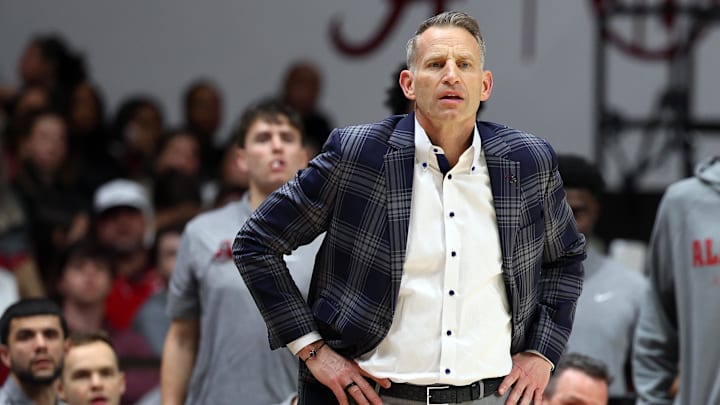
On Thursday, Alabama landed a surprise addition to its 2026 recruiting class: elite four-star small forward Jaxon Richardson. Now with three commits heading to Tuscaloosa next year, it’s clear how Nate Oats is shifting his roster construction philosophy to address the fatal flaw of this year’s roster.
Oats’s analytically driven, three-point-heavy approach is still sound, but the type of players attempting those shots is what matters in the postseason and could be the reason the Crimson Tide fall short this March.
Jaxon Richardson commitment solidifies Alabama’s philosophical shift for next season
A decade ago, the small-ball revolution took over the NBA, leading to a drastic uptick in three-point attempts. Naturally, that analytically-driven approach trickled down to college basketball. A decade later, three-point attempts haven’t gone down, but the prevalence of small-ball has.
It’s simply the natural evolution of the sport. As young players realized they needed to space the floor and knock down outside shots to play at the college and NBA level, all players, not just undersized guards wanting to be the next Steph Curry, began to develop their three-point shot. Now, it’s not enough to take 30+ threes a night because if you can’t get stops on the other end, you’ll eventually run into a team that can match you bucket for bucket.
Alabama’s issue on the defensive end this year isn’t necessarily a lack of front-court depth or the absence of a reliable backup center behind Aiden Sherrell. Oats doesn’t just need size; his roster needs positional size.
Alabama’s most common five-man lineup this season features 6-foot-1 Aden Holloway, 6-foot-3 Latrell Wrightsell, and 6-foot-4 Labaron Philon Jr. That three-guard lineup, with any other two players on the floor this season, has a defensive rating of 122.1, which is 4th percentile nationally (per CBBanalytics.com). That group also allows a 36.1 percent offensive rebound rate to opponents, which is simply unsustainable over long stretches.
The Holloway, Wrightsell, Philon lineups are lethal offensively, but there are too many weaknesses on the other end of the floor to be trustworthy in March.
Holloway will likely be back next season, and the viability of even one undersized guard is still unclear. Purdue has similar defensive deficiencies with Braden Smith, and he’s one of the best true point guards in college basketball history. Still, the infrastructure around Holloway, if he does in fact come back, will be much bigger and, therefore, much better able to hold up defensively, switch 1-5, and still provide ample offensive firepower with playmaking wings who can knock down outside shots.
Richardson is 6-foot-6, as is incoming four-star Tarris Bouie, and composite five-star Qayden Samuels is 6-foot-5. Oats will need to do more in the Transfer Portal to build out the rest of the roster in that image, but his recruiting class signals a philosophical shift that is a few years overdue.
 Add us as a preferred source on Google