

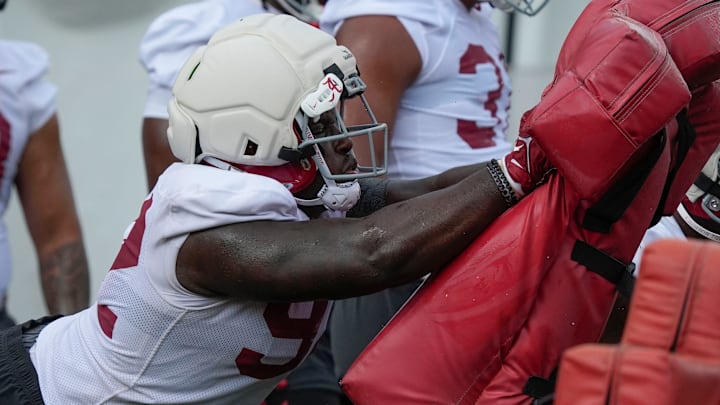
In life and in sports, opportunity often arrives when you least expect it, with it rarely being under ideal circumstances. An injury to a teammate or co-worker being sick and out of work can suddenly push an individual who was previously in the background into the spotlight, giving them a chance to prove they, too, could be counted on all along. For Alabama football, that situation is unfolding for a handful of reserves this spring as the Crimson Tide is expected to be without players at key positions for the entirety of spring ball: defensive lineman London Simmons, offensive lineman William Sanders, and tight end Danny Lewis Jr.
While their absences are far from ideal for Kalen DeBoer and company, these openings could prove valuable for several reserves across the roster as they're now set to receive increased practice reps ahead of the 2026 regular season.
At a program like Alabama, like many around the college football map, spring ball has served as a proving ground where unexpected opportunities often help shape the next wave of contributors. Similar situations have unfolded in the past when injuries created openings for young players to emerge. For example, during the spring of 2014, an injury to offensive lineman Brandon Greene allowed future All-SEC tackle Cam Robinson to shoulder more responsibility upfront. The following year, injuries to defensive lineman DaShawn Hand opened the door for then-redshirt freshman Daron Payne to expand his role within Nick Saban's defense. That same scenario played out in the secondary in 2016 when Tony Brown's absence gave rising defensive back Minkah Fitzpatrick the chance to step up and showcase the versatility in spring that later made him one of the nation's top defenders.
These past occurrences and their abilities to work out successfully in those situations are why I encourage Crimson Tide fans not to overreact to these sudden developments ahead, with Alabama set to get the ball officially rolling this Sunday. With that in mind, here are players I've specifically pinpointed on the Tide's roster who have the most opportunities to take advantage of these three particular absences on both sides of the football this spring:
The players most likely to step up for Alabama this spring with injury absences
Defensive Line — Jeremiah Beaman, Edric Hill, Kedrick Bingley-Jones:
With Simmons temporarily out of the picture this spring, Beaman comes first to my mind as one of the most intriguing candidates to capitalize on his absence in the defensive line room. Many thought he was next up last fall in the wake of former starter Tim Keenan III's absence to start the season. That is, before Beaman went down himself with a season-ending injury during practice in week two of the season, after coming off of an impressive offseason where he flashed repeatedly throughout spring and fall camp.
At 6-foot-4, 314 pounds, and with a season of film watching under his belt while rehabbing, this spring is the perfect time for Beaman to reestablish himself with Simmons sidelined. Beaman has filled early roles on the Alabama defensive front as a sub-package and rotational interior worker in the past, but these upcoming practices could be vital as the redshirt sophomore comes in more motivated than ever with plans to prove that he can be a starter down the road if needed.
Another player who could benefit from the extra workload, in my opinion, is redshirt junior, Edric Hill. Hill returns with more experience than many of Freddie Roach's reserve interior options, after logging over 20 tackles, including 11 solo stops, three tackles for loss, and one sack in 2025 as part of the defensive line rotation, alongside Simmons.
At 6-foot-3 and 284 pounds, he possesses the size and physical tools that the Tide front seven covets. Simmons' absence should allow the Kansas City native to work more frequently in drills this spring, offering him an opportunity to accelerate his development in the eyes of DeBoer and his defensive staff while further proving that he can indeed hold up against SEC-caliber offensive linemen in a starter's role.
Meanwhile, Bingley-Jones enters the spring as perhaps one of the most physically imposing options in the room for Wommack to pick from, and could also see a notable bump in reps. The redshirt-senior now in his 7th season would give Alabama the experience they lack after transferring from Mississippi State, where he featured in 43 career contests, with 19 starts, while racking up 39 total tackles, including 2.5 tackles for loss, and one pass breakup.
With Simmons unavailable, this spring period now provides the 6-foot-4, 320-pounder with the prime opportunity to solidify himself as a dependable rotational option heading into the 2026 regular season while demonstrating that he can consistently impact the line of scrimmage when given more leash to do so.
Offensive Line — Casey Poe/ Kaden Strayhorn:
With Sanders missing the entirety of spring practices, two specific Alabama offensive linemen ring bells in my head as viable options for DeBoer and new offensive line coach Adarian Klemm to lean on during this portion of the offseason. Those two names being Poe and Strayhorn, are players who could benefit from the increased development and extended rotational reps.
Poe, a versatile interior blocker with the positional frame at 6-foot-5 and 310 pounds to play multiple guard spots along the Tide's offensive front. And Strayhorn, who brings a more technically refined approach to leverage and hand placement at 6-foot-4 and 305 pounds, each has a chance to show the coaching staff how they function in extended practice settings.
While both are raw and inexperienced, having zero combined college starts between them, this opens valuable evaluation snaps for both without the threat of a veteran presence in front of either. Both will have their chances to work directly against the first team's defensive front during drills and scrimmages. If either player can demonstrate consistency in pass protection sets, maintain pad level in run blocking scenarios, and handle the mental processing demands of Ryan Grubb's offense, then either one could position themselves as a prime candidate to enter the 2026 depth conversation at the top of their position along Alabama's offensive interior front.
Tight End — Marshall Pritchett/Josh Ford:
With Lewis Jr. missing his second consecutive spring with injury, the door opens for the next wave of tight ends in the room to carve out early momentum, particularly for Pritchett. Listed at roughly 6-foot-3 and around 240 pounds, he has the critical opportunity to demonstrate functional blocking strength and reliability as an inline option to DeBoer and new Alabama tight ends coach Richard Owens.
These attributes will be key more than receptions for the sophomore tight end after showing that he could be a threat in the passing game in his first season, reeling in seven receptions for 57 yards across 15 games. With teammate tight end Kaleb Edwards being more of a weapon in the passing game last season, Pritchett's path to consistent playing time will most likely depend on showing consistency as both a point-of-attack blocker and dependable underneath receiver. Both traits the coaching staff will be evaluating closely while Lewis is sidelined. If he can string together strong practice performances, the Georgia native could position himself as a primary depth option heading into fall camp.
Another name positioned to benefit from the absence of Lewis is Josh Ford, Oklahoma State transfer tight end. Ford enters his first season in Tuscaloosa after two seasons in Stillwater, where he reeled in 13 receptions for 137 yards and two touchdowns across 16 games. The 6-foot-4, 255-pound junior provides the Tide with a slightly bigger frame that gives him an intriguing profile as a potential hybrid tight end who can contribute in heavier personnel packages. Ford's opportunity this spring will likely revolve around proving he can separate in short-yard passing concepts and being more of a physical blocker in the run game.
With these parameters all being laid out, it'll be interesting to see how all these players listed above can compete and just who exactly can make the most of their opportunities in the eyes of DeBoer, Wommack, Grubb, and their individual position coaches, with additional attention put on them throughout the entirety of this spring. And if any can successfully rise above the others, then that might just change the dynamic of both sides of the football for Alabama heading into the fall and the 2026 regular season.
 Add us as a preferred source on Google