

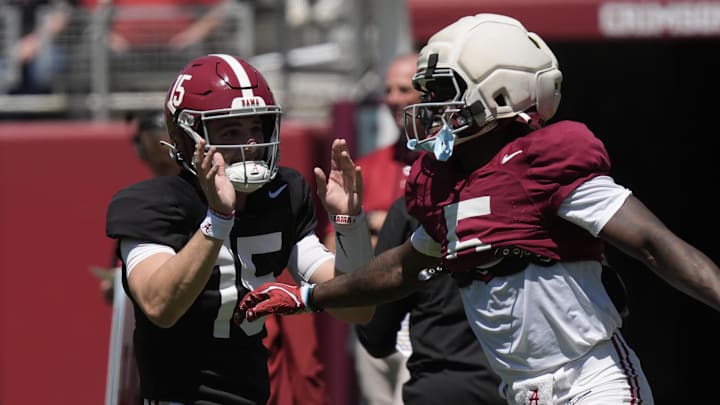
When a new artist drops a debut album or single, and it climbs the charts, most listeners instinctively begin searching for comparisons within the genre to those they already know, lining up its sound with those who came before. Asking or saying to themselves, for example, in rap, "Does this sound like early Drake?", "He's got that Jay-Z/Lil Wayne flow," while some pop artists are compared to the aura of Michael Jackson, and technically precise performers are sometimes viewed through the prism of Prince.
Music often uses a proven frame to determine rising talent. That's exactly how NFL scouting works, too, when evaluating player measurables, traits on tape, and the makeup of prospects who wish to play on Sundays. And for Alabama football's top prospects, this concept carries heavy weight in the eyes of many ahead of April's 2026 NFL Draft.
In this process, player comps aren't meant to place prospects in someone else's shadow, but to help their talents into something more recognizable in the eyes of readers and fans. That context is especially important when evaluating what a player has already shown at the collegiate level in order to project how their skillset will project at the next level. With that in mind, I've outlined three of Alabama's top prospects based on how their playing styles could fit into the NFL landscape ahead of the 2026 draft cycle.
NFL comparisons for Ty Simpson, Kadyn Proctor, and Germie Bernard
1.) QB — Ty Simpson:
At 6-foot-2, 215 pounds, Simpson's build seems to match the makeup of the leagues modern day mobile pocket passer profile. Despite only having one season of starting experience under his belt at Alabama, the redshirt junior's game is undeniable, passing for 28 touchdowns to 5 interceptions for 3,567 yards, resulting in a 64.5% completion rate through 15 games. This is why I liken Simpson to these 3 NFL signal callers ahead of his professional career:
Comp A: Brock Purdy
- Why:
Simpson, like Purdy, stands 6-foot-2 and weighs around 220 pounds. Both QBs are rhythm-based pocket passers with sneaky mobility that helps them extend plays when things break down outside of structure. No, Purdy isn't a speed demon, but with his NFL Combine 40-yard dash clocking mid-4.7 seconds, he's shown in the league that defenses must still account for his functional athleticism, much like Simpson did at Alabama last fall on later downs.
Simpson, like Purdy, wins more through timing, accuracy, and structured progression reads rather than elite velocity. Both of their upsides are tied to footwork consistency, offensive environment, and proper development from their play callers.
Comp B: Mac Jones with a mix of Tony Romo
- Why:
In the eyes of Alabama fans and many around the football universe, the comparison to Jones is probably one of the more natural stylistic parallels for Simpson, especially from a frame and system-execution standpoint. Jones, coming out of Alabama, entered the NFL at 6-foot-2, 205-210 lbs, while Simpson is listed in a very similar range. Neither is a power runner, but both emphasize well with pre-snap identification and quick distribution. Simpson, like Jones, had limited starts at the college level, with Jones logging 17 starts in his career in Tuscaloosa to Simpson's 15. Even still, both have shown similar strengths to be processor-first passers at the line of scrimmage, who operate best inside concept spacing. Neither project as a passer as a pure "arm-strength" standout, but both have shown the ability to make every necessary NFL-level throw when mechanics are clean, displaying accurate consistency over raw zip.
In Romo's case, Simpson, like the former Dallas starter, shows traits of a QB who can operate creatively within the pocket when pressure arrives. Both are comfortable resetting their platforms to make throws off timing shifts rather than abandoning structure completely. To me, the "play extension without being a true scrambler" element is the strongest theme shared.
2.) OL — Kadyn Proctor:
At roughly 6-foot-7, 360 pounds, the best way to describe Proctor is a mass-frame power tackle with developing movement polish, meaning his comps lean more toward massive, physical NFL edge protectors rather than pure athletic technicians. This is why I think he matches up nicely with these 2 current pro tackles who do just that on Sundays in the fall:
Comp A: Trent Brown
Brown is probably the closest body-type match to Proctor, standing 6-foot-7 himself and weighing 365 pounds. Brown, like Proctor, bases his game on anchored strength and line-of-scrimmage mass control, showing the ability to sit down against speed rushers once he gets set in pass protection. Proctor's early career value may come from overwhelming defenders with length and power rather than advanced footwork nuance, something Brown excelled in as he progressed during his first couple of seasons in the league.
Comp B: Orlando Brown Jr.
Proctor, like Brown Jr, has a functional archetype as a heavy, phone-both dominant tackle who can win with hand strength and leverage. Neither player is expected to win with elite lateral agility testing, but both rely on patience in pass sets and physical dominance if and when they can latch onto smaller defenders in the run game.
3.) WR — Germie Bernard:
Bernard is known in Tuscaloosa fittingly as "Mr. Reliable". At 6-foot-1, 205 pounds, the senior Alabama wide receiver was the catalyst of the Crimson Tide offense, showing his versatility as a consistent chain-mover and sure-handed route runner, who is capable of creating separation in short and intermediate areas. This is why I liken the Las Vegas native to two veteran wideouts who did just that on Sundays:
Comp A: Jarvis Landry
Like Landry, Bernard wins through route detail, leverage, manipulation, and strong hands in traffic. Neither player is built around elite long-speed separation; instead, they both benefit from the tough, possession-style receiver archetype. Both can operate inside the slot and outside on the numbers, then add value in yards after the catch situations through balance and competitiveness rather than pure burst in a WR2 role.
Comp B: Micheal Gallup
Both are around 6-foot-1, 205 pounds, and are physical receivers with reliable hands and YAC value. Bernard, like Gallup, enters the NFL as a polished route runner who wasn't a true burner but found ways to win at the college level with body control, contested catch ability, and physicality on short combinations. Gallup, like Bernard, plays like a scheme-friendly WR who can block and contribute in expanded roles.
With all this being said, I strongly believe, if Simpson, Proctor, and Bernard can translate and model their careers with the play styles and make up above of the player comps I've given them then they'll each have no problem making NFL franchises happy on Sundays for years to come when they all hear their names called in Pittsburgh by league commissioner Rodger Goodell, regardless of what pick or round they're taken this April during the 2026 NFL Draft.
 Add us as a preferred source on Google