

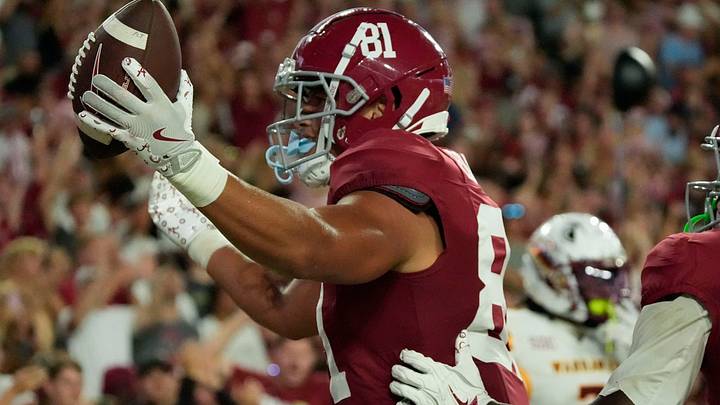
Alabama may have stumbled into a growing NFL trend that could give Ryan Grubb a different way to attack defenses in 2026.
It starts with a position group Grubb believes has quietly become one of the biggest bright spots through 10 practices of fall camp: Tight end.
That might sound like a simple development for an Alabama offense searching for more consistency in its run game. But according to Grubb's recent comments on Monday, when asked about the potential for an uptick in their usage, the emergence of the room could give the Tide another way to manipulate defensive personnel while adding more physicality on the field.
Ryan Grubb expects productive Alabama TE room to become more involved in the offense
"I do, I think they've been productive all camp," Grubb told reporters. "To me, it's just — we put those guys in position all the time for that exact reason. 'Do we wanna try to use a big-body receiver for this? Would we rather get Marshall (Pritchett) out there? Those are the kind of questions we're getting answered right now in camp. But the tight end group is one of the absolute bright spots of camp so far."
The question came after Alabama's potential use of towering 6-foot-4 and 6-foot-5 wide receivers Cederian Morgan and Derek Meadows was brought up, particularly in the red zone and in specific run-pass situations.
That's what makes Grubb's answer more revealing than it initially sounds.
He's not simply deciding whether Alabama's tight ends should receive more targets. He's figuring out which combination of players gives his offense the best answer in a particular situation. And that's where the growing NFL trend of 12 and 13 personnel could become relevant for Grubb and first-year Crimson Tide tight ends coach Richard Owens.
Owens inherits a position group that has no shortage of size and power:
Kaleb Edwards: 6-foot-6, 268 pounds
Josh Ford: 6-foot-6, 267 pounds
Danny Lewis Jr: 6-foot-5, 260 pounds
Marshall Pritchett: 6-foot-5, 246 pounds
Jay Lindsey: 6-foot-5, 258 pounds
Mack Stutter: 6-foot-5, 248 pounds
On paper, that's the kind of personnel that can allow Alabama to get bigger without necessarily becoming one-dimensional. And that could be significant considering how sparingly Grubb utilized 12 personnel — one running back, two tight ends, two wide receivers — on 35% of its snaps in 2025, while 13 personnel — one running back, three tight ends, one receiver — accounted for just 5%.
That leaves plenty of room for Alabama to expand its usage in 2026.
A second tight end can give Grubb another blocker inside or on the perimeter and help an Alabama run game that averaged just 3.4 yards per carry last season. But unlike an offensive lineman, that same player can release into a route and remain a legitimate passing threat.
That's where Edwards, Ford, Pritchett, and the rest of the Crimson Tide's tight end room make the equation more interesting.
If Alabama puts two tight ends on the field with one of its big-bodied receivers in Morgan or Meadows outside, defenses have to decide how they want to respond. That's where Grubb's NFL experience becomes more valuable when creating favorable matchups in the passing game while forcing defenses to choose between staying in the nickel or adding size and potentially opening opportunities elsewhere.
For Alabama, that could be the biggest benefit of having a versatile tight end room: more ways to get physical without becoming more predictable. And if Grubb can make those combinations work, 12 and 13 personnel could give the Tide one of its most underrated weapons in 2026.
 Add us as a preferred source on Google