

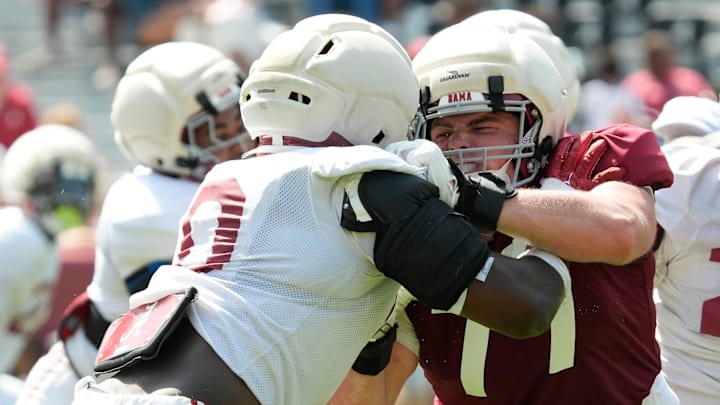
For Alabama football, every offseason starts with the familiar belief that the talent will be there. It always is. The real question is whether it shows up in sync when the lights come on. And ahead of this September, that question feels especially pointed at the Crimson Tide's retooled offensive line unit that is still searching for cohesion coming out of spring under Kalen DeBoer and new position coach Adrian Klemm.
The pieces are promising, but the ceiling is unproven. The margin for error is thin, and Alabama's 2026 regular-season schedule offers little air space when it comes to developing chemistry. This fall, the Tide is preparing to walk straight into a gauntlet of defenses designed to expose hesitation, breakdowns, and inexperience at the line of scrimmage. That's where the real evaluation begins.
Not in theory, not in spring or fall camp reps, but in live fire against units that don't just test technique—they punish lapses in it. And by the end of it, we'll know exactly what this group is made of. But that clarity won't come in abstract—it'll come through a series of opponents that will, each in their own way, force DeBoer and Klemm to answer questions in real time. And looming in the middle of that stretch are four particular defensive fronts that'll set the tone for everything Alabama's offensive line does or doesn't become.
Georgia Bulldogs—The benchmark front
Georgia's defensive front under head coach Kirby Smart is the standard because it's consistently complete, not just occasionally dominant or flashy. In 2026, Smart and UGA defensive coordinator Glenn Schumann are expected to place a stronger emphasis on improving the pass rush after a relatively underwhelming year by their standards, finishing with just 20 total sacks across 14 games despite still producing 59 tackles for loss. Even so, the unit maintained its identity as one of the nation's elite defense, allowing only 17.6 points per game. That consistency underscores Georgia's defensive hallmark: even when splash plays dip, the structure rarely does.
This fall, the Bulldogs will lean heavily on depth, rotation, and versatility across their front seven, allowing them to sustain physicality without much drop-off late in games. That foundation is built around a nucleus of returning and emerging contributors, including Quintavius Johnson, Elijah Griffin, Jordan Hall, Gabe Harris Jr, Chris Cole, and Rylen Wilson, among others. Together, they form a front that blends size and speed, reflecting Georgia's identity as a defense that aims to wear down opposing units like Alabama's offensive front over four quarters, where sustained pressure matters more than isolated bursts.
Texas A&M—Pure edge pressure unit
Texas A&M presents a different kind of stress test for Alabama's offensive line—less about structural suffocation and more about relentless edge pressure. In 2026, the Aggies' defensive identity under head coach Mike Elko and defensive coordinator Lyle Hemphill is expected to center on speed off the edge, where their pass rush is designed to collapse protection quickly and force offenses into hurried decisions before routes can fully develop.
This expectation comes after seeing Texas A&M finish tied for fourth nationally with 43.0 total sacks across 13 games. The Aggies' front seven returns key starters like DJ Hicks, T.J. Searchy, Daymion Sanford, alongside emerging talents like Ray Coney, Marco Jones, and impactful transfers such as Anto Saka, and CJ Mims. This unit is built to win fast, create negative plays early, and turn protection breakdowns into explosive disruption. That means Alabama's tackles and tight ends will be tested not just physically, but mentally—how long they can hold up in space without help, and how clearly they can pass off twist, stunts, and late pressure. This is where cohesion gets exposed in a different form. Not slowly but surely.
Tennessee—Tempo+Endurance Pressure Front
Tennessee's defensive front presents Alabama's offensive line with the test of lining up against raw trench violence in isolated and more sustained exposure to tempo and rhythm. Under this scenario, the pressure isn't always defined by who wins a rep but by how quickly the next one arrives. Vols head coach Josh Heupel and newly hired defensive coordinator Jim Knowles look to crank things up on the Tide after registering 37.0 sacks in 2025.
Playing in an environment like Neyland Stadium only amplifies that effect, where momentum and pace feed off the crowd and turn routine downs into extended sequences of pressure. Tennessee's 4-2-5 defense looks to do so with a wave of 11 returning players on their front alone, including experienced contributors Tyree Weathersby, Xavier Gilliam, Daevin Hobbs, and Arion Carter, among others. For Alabama's retooled front, that challenge is less about surviving individual matchups and more about maintaining cohesion on the road when the game refuses to slow down.
LSU—Chaos+NFL edge talent
Alabama's matchup against LSU presents the Crimson Tide's offensive front with the most volatile stress test on the schedule, in my opinion. This challenge is less about structure and more about controlled chaos against NFL-caliber edge talent. Under this profile, the rush doesn't arrive in a single, predictable wave. It comes in multiple layers: edge speed that forces early set points, interior penetration that disrupts the middle, and late movement that turns a clean protection into a split-second adjustment.
Going up against Lane Kiffin and the Tigers' defensive coordinator Blake Baker in Death Valley will be a battle in itself, especially considering how LSU has heavily rebuilt its front through the transfer portal by adding talented defenders like Jordan Ross, Princewell Umanmielen, and Jaylen Brown. Those additions should improve a defensive line that only sacked the quarterback 27.0 times in 2025. The Tigers also return emerging players like Gabriel Reliford and Kolaj Cobbins, while adding 2026 5-star true freshman edge talent in Lamar Brown. For Alabama's front, this will be the ultimate composure test when protecting the quarterback snap after snap.
With the expected return of Will Sanders at left guard, Racin Delgatty at center, Jackson Lloyd at right tackle, and Michael Carroll's versatility at right guard, Alabama looks to enter fall camp with a defined core it can finally build around. The final piece will come at right tackle, where Javien James, Nick Brooks, and Ethan Fields are expected to battle in August to determine the fifth starter.
That competition will more than likely decide how stable the edge protection looks before Alabama walks into the schedule to face the defensive fronts listed above. By then, the expectation for DeBoer and Klemm is clear: establish cohesion across a five-man unit capable of handling the full spectrum of the pressures they'll face. The reality will ultimately shape and potentially decide the success rate of Alabama's 2026 season.
 Add us as a preferred source on Google