

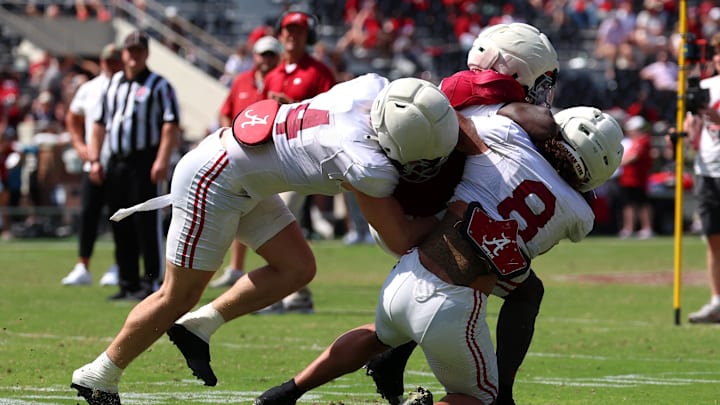
Alabama's run defense over the past couple of seasons has felt a lot like a dam that looked imposing from a distance, but up close, you could see where the pressure had started to wear on it. For stretches against mediocre rushing attacks, it held firm—limiting big leaks, forcing offenses to reroute, and even sometimes showing flashes of dominance expected in the trenches. But when facing teams that stayed committed to the run, the constant pressure would eventually expose soft spots, allowing steady gains that didn't break the structure outright, but slowly shifted control.
This spring, though, there's a noticeably different feel around the front in Kane Wommack's third season as Alabama's defensive coordinator. The dam hasn't been rebuilt from scratch, but it's been reinforced where it mattered most. New defensive line cogs like Terrance Green, DeVan Thompkins, Caleb Woodson, and Desmond Umeozulu have been inserted into the lineup, joining returning players like Yhonzae Pierre, Justin Hill, London Simmons, and a talented pool of young defenders out of the high school ranks, as the unit is looking better with more size and cohesion snap to snap. Now, Wommack's emphasis is no longer just surviving waves of pressure, but controlling the flow in a dominant fashion before it ever builds.
Still, after allowing 129.9 rushing yards per game and more than 1,900 total yards last fall, the real evaluation comes when the lights are on during the 2026 regular season. That's when rushing attacks are built to apply stress for four quarters, not spring or fall camp installation periods. Because no matter how reinforced it looks in the preseason, a defense isn't judged by calm waters—it's judged by what happens when the pressure doesn't let up from September to December.
Before those improvements are truly validated, here are four of the most physical and challenging rushing attacks on Alabama's 2026 schedule, each capable of forcing Wommack and the Tide's rebuilt front to prove it can hold up when the run game becomes their entire identity.
Texas A&M—Marcell Reed & Ruben Owens
One of Alabama's defensive lines' biggest indictments will come not from a single explosive play, but from how it handles the steady, uncomfortable rhythm Texas A&M can impose when the Aggies' dual-threat quarterback Marcell Reed is dictating the run-pass option game and running back Rueben Owens is finishing runs downhill. This isn't a "win one snap, lose the next" type of offense. It's built to test patience. Reed's ability to hold defenders in conflict forces edge discipline every time he meshes the read, and if even one defender steps out of sync, Owens is exactly the kind of back who turns hesitation into efficient, punishing gains.
That dynamic showed up last fall when Reed added a consistent rushing element alongside his passing responsibilities, totaling 493 rushing yards for six touchdowns across 13 games while averaging 37.9 yards per outing. Meanwhile, Owens became the complementary hammer, producing 639 yards and six scores on 119 carries, especially punishing defenses that overcommitted to stopping the quarterback. Together, they present Wommack and Alabama's defensive staff with the challenge of maintaining gap discipline, communication, and leverage for four quarters without the structure slowly slipping out of place.
Georgia—Gunner Stockton & Nate Frazier/Chauncey Bowen
Fewer rushing attacks in college football present the same level of structural stress as Georgia's, where physicality is less of a trait and more of an identity. With Gunner Stockton operating in a run-first, control-oriented system and a stable of backs like Nate Frazier and Chauncey Bowens rotating through downhill carries, the Bulldogs' ground game is built to wear down defenses snap after snap rather than search for explosives. What makes this trio so difficult to handle is not complexity, but consistency.
This was evident when seeing Stockton rush for 462 yards on 129 touches for 10 touchdowns in 2025. Meanwhile, Frazier emerged as Georgia's leading rusher with 947 yards on 173 carries and six touchdowns, with Bowens earning All-SEC freshman honors with another six scores on 103 attempts for 526 yards. Together, they served as the core of UGA's offense that averaged 182.1 rushing yards per game. For Alabama's front, stopping this kind of production becomes less about scheme recognition and more about endurance and pad level over four quarters, where every missed fit doesn't create chaos—but creates control for the offense.
Mississippi State—Kamario Taylor & Fluff Bothwell
Down in Starkville, Mississippi State presents a unique kind of challenge—less traditional power football, more modern chaos built around tempo, quarterback involvement, and downhill finishing ability in space. With 6-foot-4, 230-pound quarterback Kamario Taylor adding a dual-threat element that forces defensive ends to stay honest and Fluff Bothwell bringing a physical, north-south running style, the Bulldogs' rushing attack has the potential to become dangerous in its unpredictability rather than its structure.
Taylor rushed for 458 yards on 82 carries for eight touchdowns in 2025, closing out his first year as a starter with a breakout performance in the Egg Bowl against an Ole Miss playoff-caliber team, where he totaled 173 yards and two of those scores on 15 carries. Bothwell joined the effort, rushing for 677 yards and six touchdowns on 142 carries, while adding 80 yards on 17 carries in that same matchup against the Rebels. Together, they force Alabama's defense into constant conflict between fitting the QB run game and still accounting for downhill interior runs that punish hesitation.
Auburn—Byrum Brown & Jeremiah Cobb/Bryson Washington
Alabama's front faces its most pesky and straightforward challenge out of the four when lining up against its cross-state rival Auburn in the Iron Bowl. Auburn's rushing attack is built less on complexity and more on repetition, leaning downhill strain snap after snap. With USF transfer quarterback Byrum Brown now in the mix for the Tigers as a mobile threat capable of stressing the edge and extending plays with his legs, and a rotating backfield of Jeremiah Cobb and Bryson Washington handling the bulk of the interior workload, the Tigers will look to apply old-school SEC physicality.
Wommack and the Crimson Tide defensive staff are familiar with how annoying Brown can be as a runner after beating him twice at USF, totaling 200 yards on 46 carries without finding the end zone. Auburn's ground game, however, will look to maximize his mobility in a more structured starting role. As for Cobb, Alabama has also had success containing him in previous meetings, limiting him to 66 total yards on 20 carries and two scores across the 2024-25 meetings. Washington adds another layer as a Baylor transfer, and while he hasn't played Alabama, it's important to note that he rushed for 788 yards on 154 carries and six scores in Waco last fall.
The matchup becomes like a game of tug-of-war against your little brother; Alabama's defensive line must control Auburn's ground game at the focal point. And if they can successfully do so, then the Tide's overall talent should outweigh the Tigers' en route to their seventh consecutive Iron Bowl victory.
Across all four games, the answer won't come in flashes or individual stops, but in whether Alabama's defensive front can consistently hold its structure against every style of run—and prove it has evolved from simply resisting pressure to completely controlling it. And if the answer is positive, this will mean Alabama has become one of the more complete defenses in all of college football in 2026.
 Add us as a preferred source on Google