

For all the discussion surrounding Alabama's quarterback battle, roster turnover, and internal makeup, the Crimson Tide's 2026 campaign may ultimately come down to three numbers.
Not recruiting rankings. Not preseason polls. Not offseason hype. Just three statistical benchmarks.
If Kalen DeBoer's Alabama team reaches these marks, the Crimson Tide should find themselves firmly in the College Football Playoff conversation. If they fall short, Alabama could once again find itself looking for answers come January.
These checkpoints are where contender/pretender status is often revealed aside from everything else. Strip away the narratives, and these are the indicators that tend to travel best across a full season. They're not complicated. They're not abstract. And they don't require any crazy guesswork. They simply reveal the truth.
Here are the three simple areas that'll determine if Alabama is a true contender—or a pretender—in 2026.
1.) Run Game Efficiency—The Baseline: 4.0+ Yards Per Carry
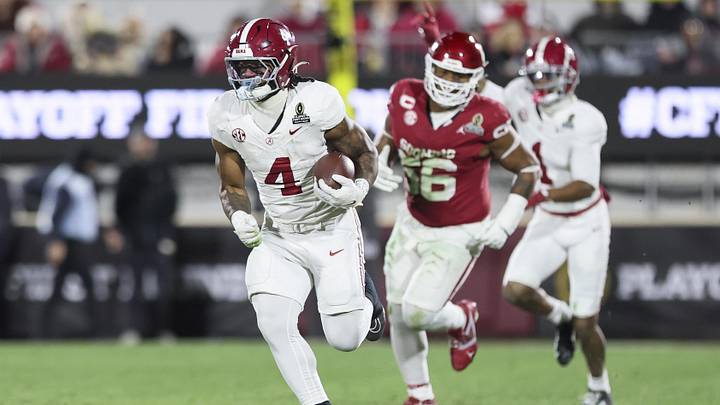
It's no secret that in 2025, Alabama's run game was among the worst ground attacks in college football. The Crimson Tide finished the season averaging 104.1 rushing yards per game, but the deeper issue wasn't volume—it was consistency. Too often, Alabama failed to stay ahead of schedule on the ground. Instead of setting up manageable down-and-distance situations, the run game frequently stalled drives and forced the offense into predictable passing situations. That lack of balance made it harder for the entire unit to find rhythm, regardless of who was on the field.
Behind the rotation of Jam Miller, Daniel Hill, Kevin Riley, and AK Dear, Alabama's rushing attack averaged 3.4 yards per carry as a team and totaled 1,152 yards for 14 touchdowns—an underwhelming output for a program built on controlling the line of scrimmage. That's what makes the 4.0 yards-per-carry benchmark so important in 2026.
Fortunately for Alabama, there are reasons to believe that number can improve. The Crimson Tide returns three of four backs from last fall with the addition of talented freshman duo EJ Crowell and Tre'Shawn Brown. More importantly, Alabama has reconstructed its offensive line through Racin Delgatty, Michael Carroll, and Jackson Lloyd, alongside projected starters Will Sanders and Jayvien James. Combined with the added run-pass option element that either Keelon Russell or Austin Mack can provide at quarterback in Ryan Grubb's offense after Alabama utilized RPO concepts on just 10.1% of its snaps in 2025, the Crimson Tide has the pieces in place capable of clearing that 4.0 yards-per-carry threshold to reestablish the offensive balance that was missing a season ago.
2.) Defensive Disruption—The Standard: 40+ Team Sacks
Alabama's defensive coordinator Kane Wommack has stressed the need for consistent disruption up front after the Tide were inconsistent in doing so with just 33 total sacks in 2025—not just pressure that shows up in flashes, but pressure that travels snap after snap, series after series. That distinction is what separates good defenses from elite ones at every level of football. In years past, when Alabama has been at its best historically, that constant disruption has wrecked the timing, rhythm, and decision-making of the opposing offenses, giving the Tide's front seven the ability to dictate terms rather than react to them. That's why the 40-sack benchmark is so pivotal to reach in 2026.
It's not just a stat—it's a reflection of control.
Alabama should be in a far better position to meet that standard this fall. DeBoer and Wommack added impact pieces through the transfer portal in Devan Thompkins, who brings versatility off the edge, Desmond Umeozulu, who adds length and burst, and interior reinforcements in Terrance Green along with Kedrick Bingley-Jones, all of whom should help generate more pressure consistently. Just as important is continuity: Yhonzae Pierre, Justin Hill, Edric Hill, Jeremiah Beaman, Isaia Faga, and Steve Bolo Mboumoua, among others, return system familiarity under Wommack, while talented freshmen like Xavier Griffin, Jamarion Matthews, and Nolan Wilson add another layer of explosiveness and depth to a rotation built to sustain pressure, not just flash it.
3.) Hidden Yardage in the Third Phase: Top-30 Special Teams Efficiency
Alabama finished 109th nationally in special teams efficiency, a number that directly reared its head on a weekly basis. The Tide converted just 69.9% of its field goal attempts, leaving points on the board in tight situations. In the field position battle, Alabama netted a punting mark of 41.5-yards per attempt—serviceable, but not game-changing enough to flip the field in their favor. The return game failed to provide fireworks as well, averaging just 8.5 yards per punt return with zero touchdowns, while kick returns sat at 17.1 yards per attempt without consistently shifting momentum.
The pathway to improvement is already in place with the additions of Lorcan Quinn and Adam Watford, two specialists who raise the floor of consistency in both kicking and punting operations. The return game is still a question mark for DeBoer and Alabama special teams coordinator Jay Nunez, particularly in terms of who ultimately will be fielding kicks, but the Tide appear to have more speed and more ball-in-space talent across the wide receiver and running back rooms than in 2025. And if that added speed translates cleanly into the return phase, Alabama has a realistic chance to turn this department into a meaningful edge that helps swing close games in its favor.
With that being said, if Alabama hits these three benchmarks, it won't just be a more competitive team—it will be a legitimate College Football Playoff contender built to survive the SEC grind and thrive in November and beyond. If it doesn't, the same efficiency games that showed up in 2025 will resurface, and the difference in pretender status will again be exposed in the margins rather than talent on paper.
 Add us as a preferred source on Google