

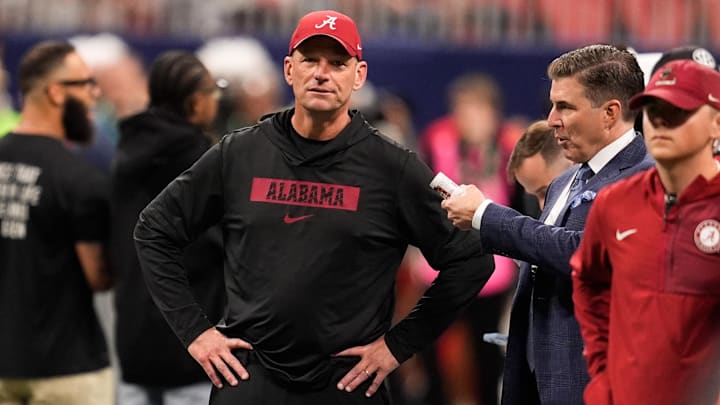
Alabama went into the SEC Championship Game in the College Football Playoff field. It was assumed that the only thing Alabama couldn’t do in its rematch with Georgia was get blown out. Then, Alabama got blown out, 28-7, finishing with -3 rushing yards and never having a chance in the game.
Yet, the CFP selection committee looked favorably on the Crimson Tide on Sunday, keeping them at No. 9 in the bracket and sending them to a first-round rematch with Oklahoma in Norman on Friday, December 19.
So, why did the Crimson Tide not drop after such a lifeless performance? Well, you can get into the politics of the committee not wanting to disincentivize conference championship games by dropping a team for losing in an extra game while keeping teams like Texas A&M and Ole Miss in the field after missing out on a trip to Atlanta.
However, obviously, that was not the argument that CFP committee chair and Arkansas athletic director Hunter Yurachek used to justify what has gone over as a controversial call to keep Alabama in as an at-large bid while Notre Dame was left out.
Hunter Yurachek explains why Alabama wasn’t punished for SEC Championship Game loss
“We evaluated all of those conference championship games, and felt like in the end, regardless of Alabama’s performance yesterday, their body of work in those first 12 games where they had, probably, the best win this season, winning at No. 3 Georgia, having a win against Vanderbilt, wins against Tennessee, as well,” Yurachek told Rece Davis on ESPN’s College Football Playoff Selection Show in the minutes after the reveal.
“Their strength of schedule was the highest in the top 11, and we felt like, in spite of their performance yesterday in the conference championship, they deserved to stay in that nine spot.”
That argument makes perfect sense, and while some of the outrage over Alabama’s inclusion has to do with their lackluster performance on Saturday, other arguments, probably more well-founded ones, have to do with the handling of the teams behind Alabama and the committee’s inconsistent logic.
Alabama stayed at No. 9 despite being blown out in the conference championship game. Yes, it was to a team it had previously beaten, so it’s not a one-to-one comparison, but BYU, in a rematch against Texas Tech after an early-season loss, was also blown out and dropped from No. 11 to No. 12.
BYU’s punishment for losing in the Big 12 title game triggered Miami, which was at No. 12, and Notre Dame, which was at No. 10, to be evaluated back-to-back. So, with Miami’s head-to-head win over Notre Dame in Week 1, the Hurricanes jumped the Fighting Irish to grab the final at-large bid despite both teams being idle on Saturday. If BYU had not been punished for its loss, that, presumably, would not have happened.
A theory on why BYU got punished an Alabama didn’t
So, how can Alabama escape a conference championship blowout unscathed while BYU gets dinged and Notre Dame loses its shield? Well, it’s possible that Duke might be responsible.
If Virginia had beaten five-loss Duke in the ACC Title Game, the conference would have had a representative in the field. After Duke’s win, James Madison became the fifth-highest-ranked conference champion, bumping the ACC. So, maybe the committee did the ACC a solid, dropped BYU to trigger a head-to-head comparison (which isn’t some kind of rule they could have factored that in whenever they wanted to), but couldn’t justify putting Miami over Alabama, so the Tide stayed put.
Or, maybe, BYU played three games against playoff-caliber or borderline playoff-caliber teams this season, and went 1-2 with a -46 point differential and was blown out by Texas Tech in both of its chances to prove itself. While Alabama already had a road win over Georgia, along with, as Yurachek said, wins over Vanderbilt, Missouri, and Tennessee.
Even with three losses, Alabama’s resume had significantly more footholds than BYU’s. I don’t dismiss the conspiracy aspects of this. The committee has a lot of politicking it has to do, and Notre Dame, without a conference affiliation, is the easiest to throw by the wayside, but you can follow the logic for each of the decisions made on Sunday’s rankings.
Justifying the path that got them there, with Miami jumping Notre Dame while neither team played, and Miami climbing from No. 18 into the playoff while beating almost no teams of consequence down the stretch, that’s questionable.
 Add us as a preferred source on Google