

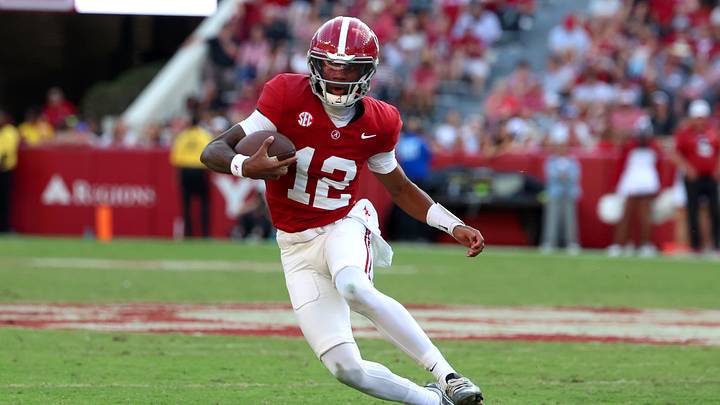
Keelon Russell is about to enter a season that will test more than his ability to play quarterback.
It will also test how well Kalen DeBoer, second-year offensive coordinator Ryan Grubb, and Alabama quarterbacks coach Bryan Ellis can hand the keys to a young quarterback, giving him enough freedom to make the Crimson Tide offense his own without putting too much of a burden on his shoulders. And as Russell prepares to finally pull out of the driveway, the program has a recent case study worth reviewing before the road gets underway: "The Manning experience".
Arch Manning's first season as Texas' QB1 in 2025 offers a valuable blueprint for navigating the challenges that come with putting a young quarterback behind the wheel. The circumstances aren't identical, and Russell doesn't need to follow Manning's path. But these three specific lessons Steve Sarkisian and the Longhorns learned while navigating Manning's first season could help Alabama avoid some of the same bumps as Russell begins his own.
1. Don't protect Russell so much that you limit his strengths
Manning's very first start against Ohio State offered an early glimpse of how that balance can be difficult to find.
Through three quarters, Manning had just 38 passing yards before finishing 17-of-30 for 170 yards. He also rushed 10 times for 38 yards. After the game, Sarkisian acknowledged his regret for not incorporating more designed runs for Manning earlier. Texas eventually found better balance as the season progressed, allowing Manning's mobility in the run-pass-option game to become a bigger part of the offense.
Lesson: DeBoer and Grubb can't confuse protecting Russell with making him conservative.
Russell's legs are one of his most underrated strengths. Rather than taking that element away in an effort to make his first season easier, Alabama can use it to make the entire offense easier on him. The threat of Russell as a runner can force linebackers and safeties to hesitate instead of immediately triggering downhill in coverage, creating cleaner throwing lanes and more favorable numbers in the run game.
Last year under Ty Simpson, the Tide offense ran RPO & zone-read concepts on just 10.1% of snaps, leaving the remaining 89.9% heavily on the run game
— Trevion D. Ware ¹ᴷ📟 (@Tware1k) April 13, 2026
Here's how Keelon Russell's dual-threat ability could revive Alabama's run game in 2026 @Bama_Hammer 👀⬇️https://t.co/6kDsQjmePr pic.twitter.com/cT5m1Y0LFY
In other words, Russell's legs can be part of the protection plan rather than something Alabama protects.
2. Don't make Russell the solution to every problem Alabama has on offense
Manning's first season also showed that a young quarterback can only overcome so much when the problems around him begin to pile up.
Texas' offensive line had its own struggles, including a particularly difficult stretch against Florida when Manning faced 35 pressures and six sacks. The Longhorns' run game also failed to provide the kind of consistent balance that could have helped take some of the pressure off their young QB.
That's an important parallel for an Alabama offensive line that is dead set on resurrecting its run game behind a newly rebuilt offensive line.
Lesson: If the offensive line struggles, the scheme needs to help compensate. If the run game isn't producing, Alabama needs to find ways to keep Russell out of obvious passing situations. If defenses are consistently creating pressure, DeBoer and Grubb must build an offense that helps its young QB overcome its weaknesses rather than asking Russell to constantly make something happen.
3. Don't let the pressure of being great prevent Russell from developing naturally
Because of the legacy attached to his family's name, Manning entered 2025 with enormous expectations. He was already being discussed as a potential Heisman Trophy winner and future No. 1 overall draft pick before taking over as Texas' full-time starter. When he struggled early, those expectations only amplified the scrutiny surrounding every mistake. But as he grew more comfortable and confident each Saturday, Manning's season later became a reminder of how much can change with experience.
The quarterback Sarkisian and his staff saw looked more poised, consistent, and in command later in the season than the one who opened the year.
Lesson: Like Manning, Russell has already received preseason Heisman hype from several national outlets around the country. That level of expectation can make every early mistake bigger than it actually is. DeBoer and Grubb can't allow one bad game — or even a bad month — to dictate how Russell is developed. He's going to make mistakes. That's inevitable.
The more important question isn't whether he struggles. It's how quickly Russell learns from those mistakes.
Is he processing defenses faster in October than September? Is he protecting the football better? Is he making quicker decisions? Is Alabama's offense becoming more efficient?
The evaluation can't simply be about where Russell starts. It has to be about where be finishing.
All that being said, the Manning experience isn't a blueprint for perfection — it's a reminder that young quarterbacks need room to grow, no matter how talented they are. DeBoer, Grubb, and Ellis have a chance to learn from those lessons before the Tide encounter the same roadblocks. Now that the keys are firmly in Russell's hands, how smoothly the drive goes will depend on how well Alabama's offensive staff prepares him for the road ahead in 2026 and beyond.
 Add us as a preferred source on Google