

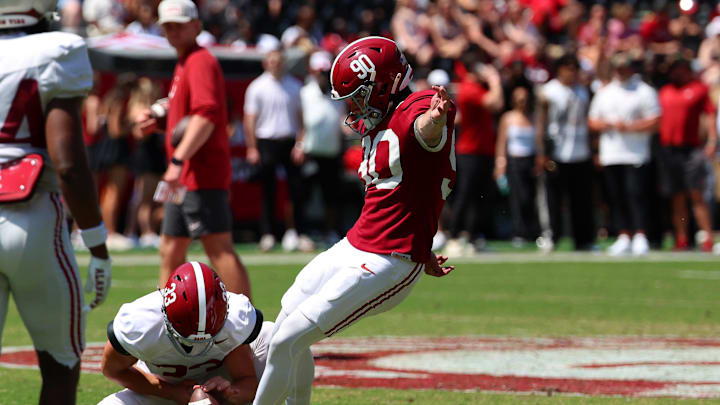
As Alabama football wrapped up its 15th and final spring practice on Thursday, the focus of Kalen DeBoer wasn't just strictly evaluation—it was resolution. While coming into 2026 with more moving pieces than established answers across the Crimson Tide roster, the last month and change has been about identifying solutions rather than simply collecting information.
That shift matters because spring ball in Tuscaloosa wasn't about just settling depth charts as much as it was about stress-testing the parts on the roster that could swing games in the fall. DeBoer and the Tide staff spent the past 39 days trying to turn uncertainty into reliability, from finding new levels of consistency with key players to narrowing the variance on special teams to expanding what certain personnel groupings can realistically be effective on Saturdays in the SEC.
Now, with spring complete and a clearer picture of what's actually sustainable ahead of the fall.
3 positive solutions Alabama discovered during spring
1. Kicking game: Lorcan Quinn— "A stabilizing weapon for Alabama's special teams unit in 2026"
Quinn emerged as Alabama's clearest solution at kicker this spring after separating himself in the Crimson Tide's kicker battle with Connor Talty, giving the Tide's special teams unit a new level of consistency that they lacked a season ago.
In 2025, the kicking game stood out as one of DeBoer's most volatile phases. The staff cycled through options searching for reliability, but inconsistency from Talty at a distance and in pressurized moments kept the unit from becoming a true asset. That uncertainty carried into Alabama's A-Day spring game, where Talty notably missed a 38-yard attempt, en route to going 2-of-3 on the day.
Quinn, however, began closing the door on the conversion in a decisive fashion. The Marshall transfer knocked in a pair of 47-yard field goals along with a 28-yarder, finishing with a perfect 3-for-3 performance. More importantly, Quinn did it in a setting designed to simulate pressure, reinforcing his case to DeBoer as the more consistent and trustworthy option moving forward.
2. Ryan Coleman-Williams' newfound level of consistency
For DeBoer and offensive coordinator Ryan Grubb, Coleman-Williams' impact was never in question, but Alabama's focus this spring was on turning flashes into sustained consistency heading into 2026. After an uneven sophomore season where explosive plays were occasionally offset by quieter stretches and untimely drops, the junior wide receiver has now taken a clear step forward in his ability to deliver snap-to-snap production.
Rather than functioning purely as a big-play threat, Coleman-Williams showed a more complete flow of executing the route tree and improved concentration when catching the football on a routine basis. The results proved to be a steadier mix of chain-moving contributions, not just highlight reel plays. He showed this in Alabama's first scrimmage of the spring, erupting for three touchdowns. That progression continued on A-Day, where he reeled in three receptions for 60 yards, working with both quarterbacks Keelon Russell and Austin Mack in a more structured passing game environment.
While doing so, Coleman-Williams has also taken the responsibility of being the veteran leader in Alabama's receiving room. That consistent climb now looks like it'll elevate his ceiling from a gadget weapon to more of a trustworthy weekly presence that DeBoer and Grubb can lean on as the Tide look to improve their offensive output in 2026.
3. Alabama's improved versatility on the defensive line
Alabama third-year defensive coordinator Kane Wommack and DeBoer found clear solutions along the defensive line this spring in its ability to build versatility across the front rather than relying on fixed roles. The staff's emphasis shifted towards creating interchangeable pieces that can line up in multiple spots, allowing the Tide to adjust fronts without substituting personnel. That flexibility became especially important in stabilizing a unit that needed more of a consistent edge pressure and interior disruption coming out of 2025.
A major part of that solution has been the expanded rotation around returning star edge rusher Yhonzae Pierre, who continues to develop into one of College Football's top defenders at the position. Around him, Alabama leaned into a deeper and more diverse group of contributors, including transfers such as Devan Thompkins, Terrance Green, and Desmond Umeozulu, who bring more size, different physical profiles, and pass-rush styles. That blend should allow Wommack and DeBoer to get away from having to rely on predictable edge usage by keeping fresh rushers on the field more consistently.
Equally important has been the internal development, where Justin Hill's continued emergence has given Alabama a more complete second-wave pass rusher capable of impacting snaps without heavy structure. Alongside Hill, other threats like London Simmons, Steve Bolo Mboumoua, Xavier Griffin, Jamarion Matthews, and depth also give Wommack multiple answers rather than a single reliance point in a more dominant pass rush and run defense structure heading into 2026.
Together, three developments point to a more balanced and dependable Alabama team, even as DeBoer and company continue to work on other areas of the roster that have still been left unsolved. At a minimum, these three apparent solutions now stand as clear building blocks and areas of stability the Tide can carry into fall camp as they prepare for the 2026 regular season.
 Add us as a preferred source on Google