

Every season in college football eventually comes down to which programs actually develop—and who doesn't. More often, they're defined by the players who swing outcomes—guys who aren't necessarily the best on the roster, but whose development can meaningfully raise or lower a team's ceiling.
That lens of reality is especially true when looking at the Alabama Crimson in 2026. As Kalen DeBoer and his staff continue reshaping one of the youngest and most retooled rosters in the nation, the difference between being a legitimate playoff contender and a team stuck outside the 12-team field may come down to a handful of breakout campaigns from players who have yet to make their mark in a Crimson Tide uniform.
Not necessarily the safest projections. Not the most established names. But the players who ultimately decide how high this team can climb. With that in mind, here are the five biggest swing players standing between Alabama and a College Football Playoff run come December.
5 Alabama players who could make all the difference for the Crimson Tide in 2026
5.) Underrated Veteran Defensive Back—The continued rise of Red Morgan:
Morgan fits the exact profile of a swing-piece type of player in Alabama’s secondary—highly coachable and experienced enough to be trusted, but not yet nationally recognized as a difference-maker.
For Alabama, Morgan’s value isn't just depth—it’s reliability. Though considered undersized at 6 feet and 189 pounds, the junior husky defensive back has totaled 34 tackles, including four tackles, two pass breakups, and two forced fumbles across 27 career games. Every time he's stepped on the field, he's consistently proven to play bigger than his frame suggests, showing physicality in coverage and a willingness to compete in run support.
Now, in 2026, as a full-time starter, Morgan’s combination of toughness and competitiveness gives Alabama a stabilizing presence in rotational snaps and matchup situations. This is what makes Morgan a true swing factor. If he takes the next step forward and holds his own as a dependable starter across a full season, Alabama gains added stability to a secondary that will be tested weekly in SEC play. If not, the Tide may be forced into less experienced rotations in critical moments—shrinking the margin for error against elite passing attacks.
4.) Young and unproven contributors—Cedrian Morgan & EJ Crowell:
This spot isn't about established production—it's about whether Alabama can unlock depth at key offensive spots.
Morgan and Crowell have both impressed early in Tuscaloosa as four - and five-star true freshman early enrollees and represent the developmental swing factor in the Crimson Tide's arsenal of young offensive skill talent. Neither needs to emerge as a superstar coming out of the gates in September, but Alabama does need at least one of them to become a consistent rotational contributor by the middle of the season.
If that happens, it expands DeBoer and Ryan Grubb’s offensive flexibility, while also improving depth stability Alabama will turn to over the course of a long SEC season. If not, the margin for error shrinks quickly when injuries or defensive game plans force the Tide deeper into their rotation.
3.) Offensive Line Stability—Jackson Lloyd & Will Sanders:
This is where Alabama’s offensive ceiling starts to get defined in real time. Lloyd and Sanders don't have to be All-American-level players in their first years as starters for this offense to function—but they do have to be stable.
If both players hold up against elite defensive front talent in the SEC, it changes everything about how Alabama can operate offensively. It allows for more true drop-back concepts, more vertical shots off play-action, and a more balanced structure that doesn't have to lean heavily on quick-game answers just to stay on schedule.
But if protection becomes inconsistent, quarterback development becomes uneven, and the ripple effect is immediate. That's why Lloyd and Sanders’ play will be a true swing factor for Alabama in 2026.
2.) Robin-type game-changing edge rusher behind Yhonzae Pierre—The growth of Justin Hill in year 2:
After totaling 10 total tackles, including 2.5 for loss, through 15 games as a true freshman in 2025, Hill's awaited growth represents the kind of swing factor that can significantly reshape Alabama’s entire defensive ceiling. He isn't being asked to be the centerpiece of the Crimson Tide’s pass rush—Yhonzae Pierre is anchoring that role—but Hill’s ability to consistently win in one-on-one matchups with Pierre highlighted could push Alabama’s defense from solid to truly disruptive.
That kind of complementary pressure matters as Kane Wommack looks to increase the consistency of Alabama’s pass rush in his third season as defensive coordinator. It prevents offenses from sliding protections entirely towards Pierre’s direction, while also creating more opportunities for Hill and others to exploit.
This small but meaningful step forward in Hill's game is what makes him such an important swing player this fall.
1.) Franchise altering—The raw development of Keelon Russell:
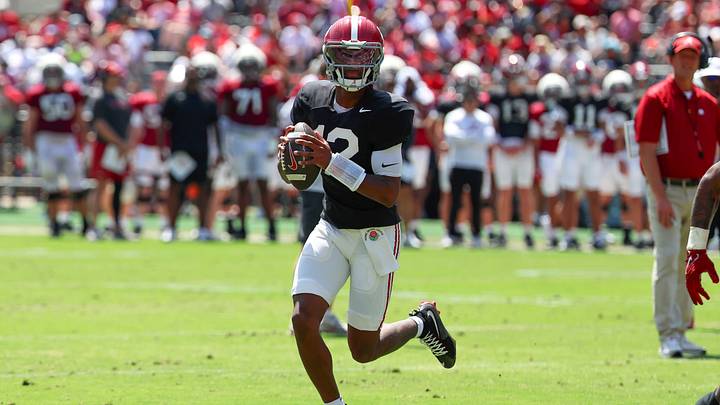
There are swing players… and then there are program definers. For Alabama in 2026, Russell doesn't just fall into the former category—he is the category. Because no single development arc on this roster has a wider range of outcomes between a “solid season” and a “legitimate College Football Playoff run” than the progression of the former five-star quarterback.
Russell’s talent has never been the question. The arm power, off-platform creativity, and natural feel for the game when things break down are the traits that have made him one of the most highly regarded prospects in the country. What's unknown is how quickly that talent translates into command of a full SEC offense—timing, protection recognition, pre-snap control, and the ability to consistently play in structure when the game speeds up.
That's where Alabama’s entire ceiling lives as DeBoer and Grubb decide between Russell and leaning on redshirt junior Austin Mack in the grand scheme of things.
If Russell accelerates ahead of schedule, many believe Alabama’s offense will shift from developmental to dangerous—and quickly enter the type of national conversation that already includes preseason Heisman Trophy whispers. If he doesn't, then Alabama will more than likely be without its most dynamic variable at the position and become dependent on playing with structure under Mack.
And that's the trade-off that makes Russell a true swing factor—because the gap between "growing pains" and "ready now" doesn't just affect efficiency; it reshapes Alabama's ceiling of a potential CFP-caliber team.
Ultimately, Alabama's 2026 season won't all be defined by its stars—it will be shaped by how quickly its unknowns become dependable. If even a few of these swing players hit, the Crimson Tide's ceiling expands to legitimate contender territory in a hurry. If they don't, the margin between contender and pretender becomes razor-thin.
 Add us as a preferred source on Google