

College football seasons are usually described as marathons, but Alabama's 2026 slate feels more like a stretch of alternating sprints and heavyweight title fights—where the opponent steps into the ring with at least one puncher's chance of changing the entire outcome.
Kalen DeBoer and his Alabama coaching staff won't just line up marquee programs—they'll face week after week of legitimate game-changers. From system-savvy quarterbacks to rising defensive stars and elite skill-position threats, the Crimson Tide will see more than just "good teams" this season. They'll see players capable of tilting matchups on a single drive, swinging momentum with one play, and forcing pregame plans to shift on the fly.
Before the matchups unfold, here's a look at the five toughest opposing players Alabama will have to account for on its 2026 slate—the ones who could define Saturdays in ways that go beyond the scoreboard.
1.) Gunner Stockton—Georgia, QB
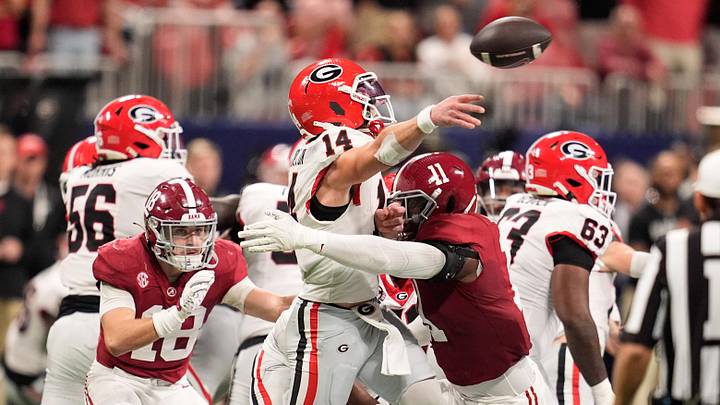
Alabama's matchup against Georgia once again centers around quarterback play, and Gunner Stockton enters 2026 looking like one of the SEC's most battle-tested signal callers. Considering the last encounter Alabama had with Stockton in the SEC Championship Game — when he carved up the Tide defense for three touchdowns while completing 20 of 26 passes for a 76.9% completion rate — he easily stands out as the biggest force Alabama will have to account for on its schedule.
What makes Stockton especially dangerous isn't overwhelming athleticism or gaudy passing numbers, it's his control. Georgia's offense operates efficiently when he's comfortable, and Alabama saw that firsthand: how quickly he can settle into rhythm if protections hold up early. Stockton also quietly hurt the Tide with his mobility during their two meetings in 2025, rushing for 61 yards on 18 carries and consistently extending drives in key moments. If Alabama cannot successfully contain him, Georgia has already proven that they can control the pace of the game and force the Tide into another long Saturday of reactionary football instead of dictating terms.
2.) Marcel Reed—Texas A&M, QB
If Stockton represents controlled efficiency, Marcel Reed is the opposite problem: structured chaos with legitimate explosiveness backed into every snap. Reed's dual-threat ability forces defenses into a constant conflict—sit back, and he has the ability to dot you up underneath; pressure too aggressively, and he's just as capable of turning a collapsing pocket into an explosive play.
Containing Reed becomes especially tricky because of how his legs can flip a drive. One missed contained lane or one late rotation over the top can turn a routine third down into a 40-yard scramble or a shot-play touchdown. Reed already showed that kind of instant-impact ability in 2025, including a 41-yard quarterback keeper for a score against LSU—an example of how one crease can become six points in a heartbeat. That athleticism has the ability to be a devastating blow that could alter the outcome of the game if Alabama loses gap discipline.
3.) Dylan Stewart—South Carolina, Edge
If Reed is a potential threat offensively, Dylan Stewart is a defensive wrecking ball who can tilt the line of scrimmage and dictate calls before the ball is even snapped. He's the type of edge defender who can distort an offensive game plan on the first drive, winning reps with an explosive first step and the kind of bend that turns an evolving Alabama offensive line into a desperate one in a hurry.
Stewart has shown this kind of disruptive nature across the board in his first two seasons with the Gamecocks, racking up 56 total tackles, including 22.5 tackles for loss, 11 sacks, and three pass deflections. Alabama's tackles must account for him on every snap, because any lapse in set or hand placement can turn into immediate backfield pressure and force timing off schedule. And if he doesn't finish the play, his impact shows up everywhere—compressed launched points, rushed decisions, and protections sliding his way just to survive the down. That kind of attention alone can open things elsewhere, giving his presence the type of edge that can swing momentum without ever touching the stat sheet in a flashy way.
4.) Princewell Umanmielen—LSU, Edge
Just like Stewart, Princewell Umanmielen is the kind of pass rusher who can cause the same headaches for Alabama's offensive line with his physical violence at the point of attack. The 6-foot-4, 245-pound junior brings a proven profile from his time at Ole Miss before transferring to LSU, compiling 45 tackles, nine sacks, one pass deflection, and one interception last fall.
What makes him so dangerous is his ability to bend and reset the edge with power if tackles overset or lose leverage early. Against Alabama, Umanmielen represents the type of presence that doesn't need volume to matter—just a handful of disruptive reps where he wins clean and forces the quarterback off his spot before the play ever fully develops. This stress can make for a long day if the Crimson Tide's offensive line isn't technically sound from snap to snap.
5.) Arion Carter—Tennessee, LB
If the edge rushers are the ones setting the table up front, Arion Carter is an opposing player who can operate in the middle by reading, reacting, and triggering Tennessee's defense with a level of range that could dictate how Alabama's offense carries itself the entire game. Carter plays like a modern second-level eraser. He has the speed to scrape sideline-to-sideline in run support, but more importantly, the processing ability to diagnose plays before they fully develop.
In his two meetings against Alabama, the 6-foot-1 and 235-pound junior has totaled 13 tackles and one quarterback hurry, while consistently remaining an active presence in the middle of the field. Whether it's flowing downhill against the run or quickly closing underneath throwing windows, Carter has shown the kind of instincts that can quietly disrupt the rhythm of the Crimson Tide's offense and force them into uncomfortable situations snap after snap. Alabama's ability to negate his presence will be key.
Vanderbilt's Sedrick Alexander and Auburn's Jeremiah Cobb also deserve honorable mention as running backs capable of creating problems for Alabama throughout the 2026 season. In a season like this, Kalen DeBoer and the Crimson Tide coaching staff aren't just chasing execution—they're chasing control against opponents built to take it away one snap at a time. And in the SEC, with these particular matchups, it'll be interesting to see how Alabama handles these opposing forces when control is never guaranteed and every Saturday demands it to be earned.
 Add us as a preferred source on Google