

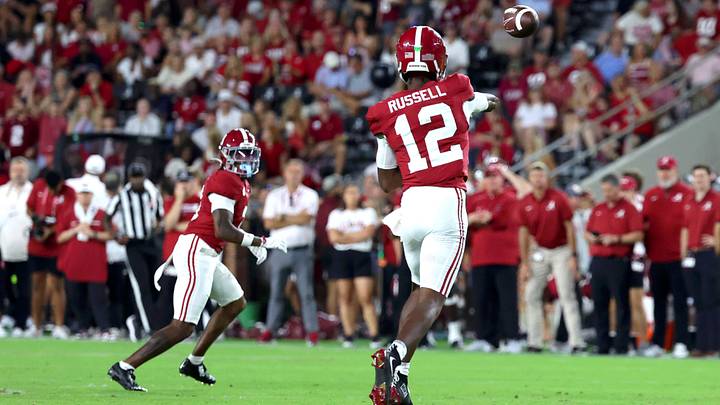
As Alabama evaluates its 2026 ceiling, attention is shifting towards a talented sophomore class that could determine whether the Crimson Tide are simply competitive in the SEC or true College Football Playoff contenders.
That conversation carries added weight given Alabama is projected to return just 41% of its production from last fall — a mark that ranks 64th in the country— and is expected to be one of the youngest teams in the SEC. This reality places even greater pressure on the early-career acceleration of Kalen DeBoer's 2025 signing class, a group that finished No. 4 nationally and best represents the backbone of Alabama's long-term roster construction.
This sophomore nucleus includes a mix of proven talent and untapped potential — Dijon Lee, Lotzeir Brooks, Justin Hill, Michael Carroll, AK Dear, Kevin Riley, Derek Meadows, Luke Metz, London Simmons, Kaleb Edwards, and Keelon Russell, among others — a group that spans every level of the roster and could ultimately shape both the identity and trajectory of the team under DeBoer in his third season in Tuscaloosa.
Luckily for DeBoer, the blueprint for that kind of leap already exists in Alabama's recent history.
Can Kalen DeBoer's first signing class replicate what Nick Saban's 2008 class did?
In 2009, under Nick Saban — the last time Alabama had a team with this much youth playing critical positions across the roster — the Crimson Tide leaned heavily on a sophomore class that rapidly evolved into a championship core. That 2008 recruiting class ranked No. 1 in the nation and didn't just take years to develop into stars; they accelerated almost immediately, reshaping both sides of the ball in a single season.
Players like Mark Ingram, Julio Jones, Dont'a Hightower, Marcell Dareus, Mark Barron, Courtney Upshaw and company became foundational pieces of a team that didn't just win games — it imposed its identity on opponents week after week en route to a National Championship. That same variable now defines the outlook in Tuscaloosa ahead of the 2026 season.
But the challenge for DeBoer this fall is that history alone does not guarantee the same results. Every championship blueprint eventually runs into the same variable: whether a young core can actually make the jump when the margin for development shrinks and the level of competition rises. For this current group, that means turning recruiting rankings and potential into production against the week-to-week grind of the SEC — where talent alone is rarely enough to survive, let alone contend for the postseason.
That's where the skepticism of the national media, Alabama fans, and those on the outside looking in has already begun to surface. The concern isn't about talent —Alabama has never lacked that — but the timing. Can a sophomore-heavy group in a roster reset truly develop fast enough to withstand an SEC schedule loaded with experienced fronts, veteran quarterbacks, and programs already in mid-cycle contention?
Because if the answer is no, DeBoer risks spending another season stuck in transition — good enough to compete with anybody, but not quite polished enough to close the gap in the moments that define playoff teams. But if the answer is yes, and this sophomore class does mirror the rapid ascent of past championship cores, the ceiling changes immediately.
In many ways, this is the defining question of Alabama's 2026 campaign. Not whether the Crimson Tide have the talent, but whether they have the acceleration for their youngest core to turn that potential into production on schedule. Because in Tuscaloosa, history shows the formula is simple — when sophomores rise fast enough, postseason success follows. When they don't, even the most talented rosters fall just short.
 Add us as a preferred source on Google